
ASUS spent 2026 showing off Wi-Fi 8. The ROG Rapture GT-BN98 Pro appeared at Computex in June, and the non-Pro GT-BN98 followed at Gamescom in August with a quad-band 25,000 Mbps rating and dual 10 Gbps ports. Both look spectacular. Neither is shipping, neither has a release date, and neither can be Wi-Fi CERTIFIED 8 — because that program does not exist yet. Here is what Wi-Fi 8 actually changes, and what makes sense to buy in the meantime.
What Did ASUS Actually Announce?
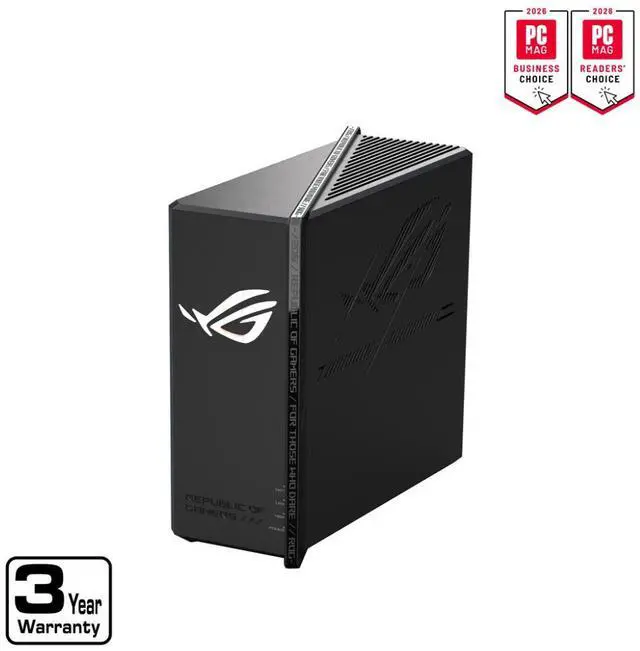
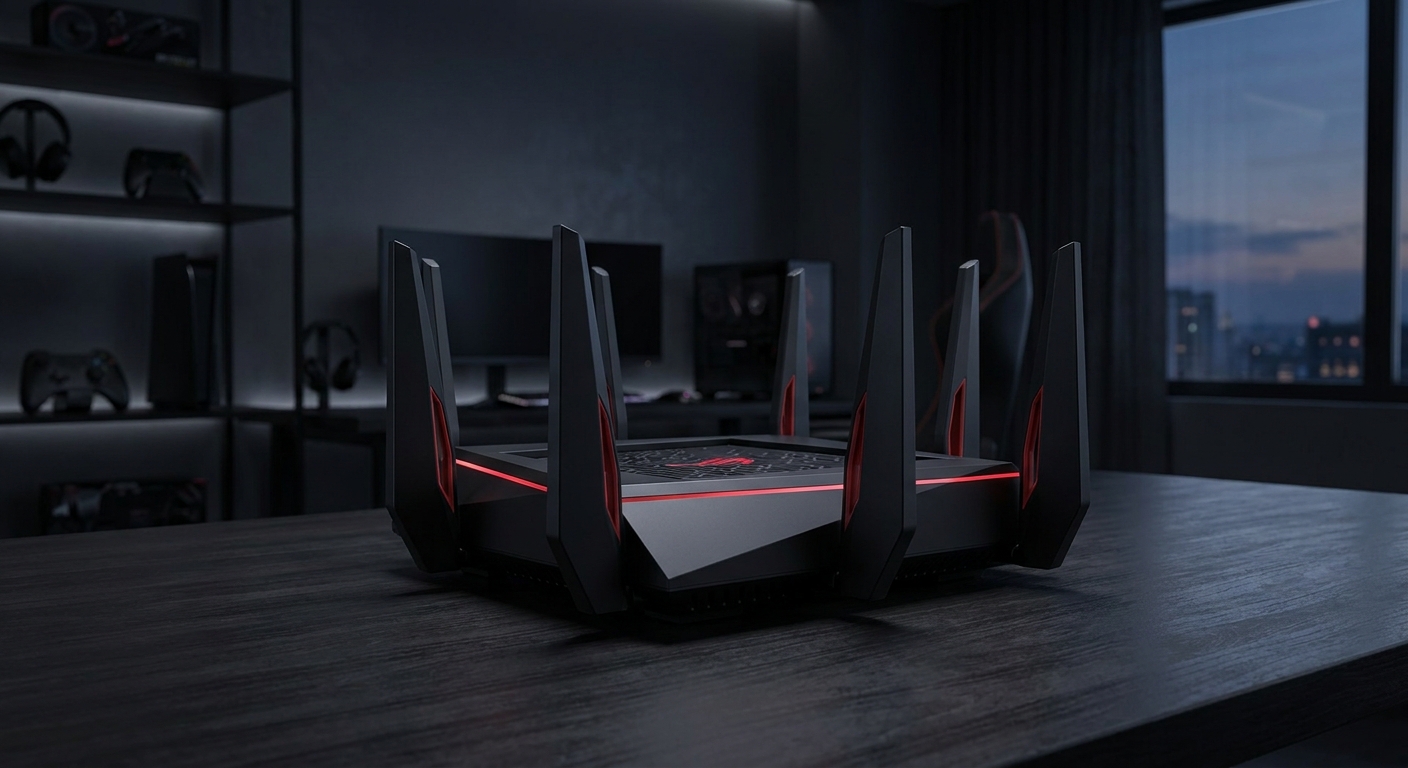
Two routers, not one. The ROG Rapture GT-BN98 Pro was unveiled at Computex on June 2, 2026: quad-band 802.11bn rated up to 30,000 Mbps aggregate, dual 10G ports supporting up to 20 Gbps link aggregation, a dedicated 10G gaming port, a 2.5G WAN/LAN plus three 2.5G LAN, eight antennas and active cooling with an aluminium heat plate. Tom’s Hardware put availability at Q4 2026 or possibly Q1 2027.
The non-Pro ROG Rapture GT-BN98 arrived at Gamescom in late August 2026: quad-band across one 2.4GHz, two 5GHz and one 6GHz radio, rated up to 25,000 Mbps, with a 2.6GHz quad-core CPU, 2GB of RAM, two 10 Gbps ports and 320MHz channels on 6GHz. Guru3D noted ASUS had not disclosed the final band configuration, processor, memory, pricing or release date.
So if you have seen the August coverage calling the GT-BN98 the first Wi-Fi 8 gaming router — the Pro beat it to the announcement by nearly three months.
Is Wi-Fi 8 Faster Than Wi-Fi 7?
No, and this is the single most important thing to understand. Wi-Fi 8 keeps Wi-Fi 7’s ceiling of up to 23 Gbps PHY rate. Peak speed does not increase at all.
The IEEE 802.11bn project is officially called Ultra High Reliability, and its targets are what the industry calls 25/25/25: about 25% more real-world throughput specifically under weak-signal conditions, 25% lower latency at the 95th percentile, and 25% fewer dropped packets — especially while roaming between access points. In other words, Wi-Fi 8 is aimed at the edge of your coverage, the far bedroom, the crowded apartment building, the moment your video call drops as you walk down the hall. Not at the number on the box.
ASUS separately claims up to double the mid-range throughput, twice the IoT coverage and up to six times lower P99 latency through multi-AP and multi-client coordination. Those are vendor figures from its January 2026 press material, not IEEE targets — worth noting, worth treating as marketing.
When Can I Actually Buy a Wi-Fi 8 Router?
Hardware may appear before the end of 2026. Certification will not. The IEEE timeline reached Draft 2.0 letter ballot in July 2026, with D3.0 due January 2027 and D4.0 in May 2027. Final IEEE approval lands March to May 2028, and the Wi-Fi Alliance’s Wi-Fi CERTIFIED 8 program is expected to launch at CES in January 2028.
That means any router carrying a Wi-Fi 8 badge in 2026 is running draft silicon against an unfinished specification. This is not unusual — 802.11ax routers retailed in 2018 and Wi-Fi CERTIFIED 6 arrived in September 2019; Wi-Fi 7 routers reached retail in early 2023 and Wi-Fi CERTIFIED 7 launched in January 2024. What is unusual is the gap. Roughly two years is the longest of any recent generation.
And there is a harder problem: there are no Wi-Fi 8 client devices. Your phone, laptop and console are all Wi-Fi 6, 6E or 7. A Wi-Fi 8 router bought today is, in daily use, a very expensive Wi-Fi 7 router.
Who Else Is Building Wi-Fi 8 Silicon?
Broadcom got there first, launching Wi-Fi 8 chipsets in October 2025 with retail products expected from summer 2026 and enterprise gear mid-to-late 2027. MediaTek announced its Filogic 8000 family at CES 2026, leaning hard on multi-AP coordination — coordinated beamforming, coordinated spatial reuse and multi-AP scheduling — with first customer shipments during 2026. Qualcomm said it would unveil a complete Wi-Fi 8 platform portfolio at MWC Barcelona in March 2026. None of the three has published consumer model numbers you can shop for yet.
So What Should I Buy Right Now?
Wi-Fi 7, and without guilt. It is only now hitting mainstream volume: 583 million Wi-Fi 7 devices shipped globally through the end of 2025, with 1.1 billion forecast for 2026, and enterprise access point revenue share climbed from 11.8% to 44.5% year over year in the first quarter of 2026. The ecosystem you would actually connect to is Wi-Fi 7.
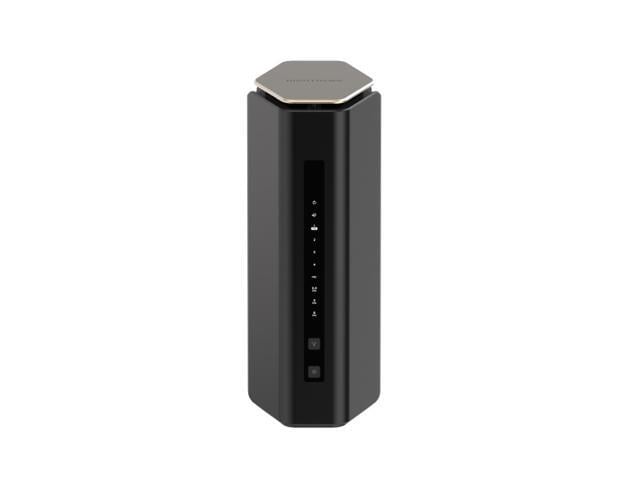
The Netgear Nighthawk RS600 is the straightforward flagship — tri-band BE18000 across 2.4, 5 and 6GHz. If your priority is wired ports instead, the ASUS RT-BE88U is unmatched at its tier: dual 10G plus SFP+, four 2.5G and four 1G ports for 34G of total WAN/LAN capacity, with 4K-QAM, MLO, AiMesh and subscription-free AiProtection.
What If Coverage Is the Problem, Not Speed?

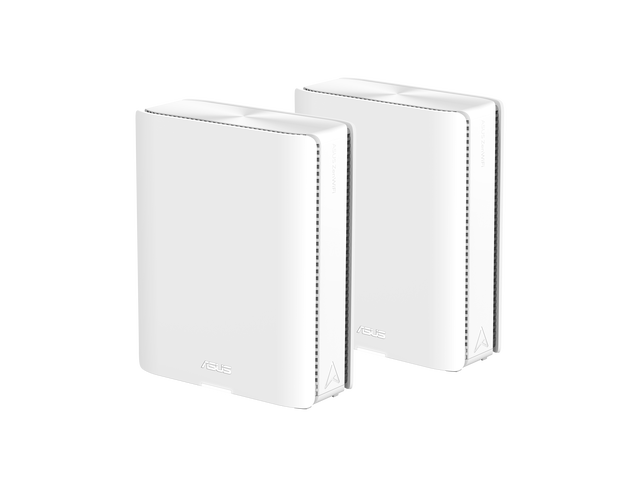
Then a mesh system fixes today what Wi-Fi 8 promises for 2028. The ASUS ZenWiFi BQ16 Pro 2-pack runs quad-band Wi-Fi 7 with a dedicated backhaul, covers up to 8,000 square feet and puts two 10G ports on each unit, with multi-SSID Smart Home Master, VPN, parental controls and AiMesh.
For a house you can run Ethernet in, a ceiling access point is the cleaner answer. The Ubiquiti U7 Pro covers roughly 1,500 square feet with six spatial streams, 6GHz support and a 2.5GbE PoE+ uplink, handling 300-plus connected devices. Note that its MLO support is listed as arriving in a future software update.
If you cannot run Ethernet, the TRENDnet TMO-312C2K 2-pack pushes up to 2.5 Gbps over the coax already in your walls, backward compatible with older MoCA gear and expandable to 16 nodes.
What About the Devices at Each End?
A fast router cannot help a client stuck on an old radio. The TP-Link Archer TBE550E brings a desktop up to Wi-Fi 7 over PCIe — BE9300 tri-band with 5,760 Mbps on 6GHz, MLO, Bluetooth 5.4 and WPA3. For a machine with no free slot, the WAVLINK BE6500 USB adapter does tri-band Wi-Fi 7 over USB 3.0 with MLO, Multi-RU and four 5dBi antennas, on Windows 10 and 11.
And once you have multi-gig ports on the router, the wired side becomes the bottleneck. The D-Link DMS-108 is a fanless eight-port 2.5G unmanaged switch with 40 Gbps of switching capacity and a limited lifetime warranty — plug and play, nothing to configure. Compare current options in Newegg’s Wi-Fi 7 router listings.
Frequently Asked Questions
Is Wi-Fi 8 faster than Wi-Fi 7? No. Wi-Fi 8 keeps Wi-Fi 7’s peak PHY rate of up to 23 Gbps — the ceiling does not move. The IEEE 802.11bn project is called Ultra High Reliability and targets roughly 25% more real-world throughput under weak signal, 25% lower latency at the 95th percentile and 25% fewer dropped packets while roaming. It improves the worst part of your coverage, not the best.
When will Wi-Fi 8 be certified? The Wi-Fi Alliance’s Wi-Fi CERTIFIED 8 program is expected to launch in January 2028, with final IEEE approval between March and May 2028. Routers announced in 2026 run draft silicon against an unfinished specification, so any Wi-Fi 8 badge today is a vendor claim rather than a certification.
Should I wait for a Wi-Fi 8 router? Probably not. No Wi-Fi 8 client devices exist, so a Wi-Fi 8 router bought now behaves as a Wi-Fi 7 router in daily use, and certification is roughly two years out — the longest gap of any recent generation. Wi-Fi 7 is entering mainstream volume with 1.1 billion device shipments forecast for 2026.
Will a Wi-Fi 8 router make my current phone or laptop faster? No. Both ends of the link have to support the standard. Your existing devices connect over Wi-Fi 6, 6E or 7 regardless of what the router supports, so the gains only arrive when you also replace the clients — which is a 2028-and-later question.
Read More
- IEEE 802.11 Task Group bn Status — The official milestone list for the Ultra High Reliability amendment, including the March–May 2028 final approval dates.
- Tom’s Hardware: ASUS Unveils Its First Wi-Fi 8 Router — The full port list for the GT-BN98 Pro and the Q4 2026 / Q1 2027 availability estimate.
- ASUS ROG: Rapture GT-BN98 — The manufacturer’s own page for the quad-band 25,000 Mbps model shown at Gamescom.
- ROG Global: What Is Wi-Fi 8? — A short official explainer on why Wi-Fi 8 targets reliability instead of peak speed.
- Newegg: Wi-Fi 7 Routers — Compare current tri-band and quad-band routers, mesh systems and multi-gig ports.