

This is the first back-to-school season where the processor inside a Windows laptop is genuinely a three-way decision. Qualcomm’s Snapdragon X2 Elite is shipping, Intel’s Panther Lake arrived as the Core Ultra Series 3 on the company’s new 18A process, and AMD has refreshed its mobile line. A benchmark report circulating in August put one of these chips ahead of another by up to 87%, which sounds decisive and is not. Here is what each platform actually is, what the headline numbers do and do not cover, and how to choose based on what you study rather than which chart looks best.

The Three Contenders
Qualcomm Snapdragon X2 Elite. Announced in September 2025, it is the first Arm PC chip to reach 5.0GHz. The X2 Elite Extreme and the X2 Elite 88-100 use 18 cores — 12 Oryon Prime plus 6 Performance — with the Extreme boosting to 5.0GHz; the X2 Elite 80-100 is a 12-core part. The NPU is rated 80 TOPS, a 78% increase over the previous generation’s 45 TOPS. It is built on TSMC 3nm with Adreno X2-85 graphics, LPDDR5x-9523 memory at 152 GB/s and USB4. Systems ship through the first half of 2026.
Intel Core Ultra Series 3, codename Panther Lake. Launched at CES 2026 with more than 200 OEM designs behind it, and the first family on Intel 18A with RibbonFET transistors and PowerVia backside power delivery, which Intel credits with roughly 15% better performance per watt. Configurations run from 8 cores up to 16, the top tier with 12 Xe3 GPU cores branded Intel Arc B390 — which Intel claims is around 73% faster in gaming than Lunar Lake. The NPU is 50 TOPS, across 14 SKUs launching in the first quarter of 2026.
AMD Ryzen AI 400 series, codename Gorgon Point. Seven laptop APUs arriving in the first quarter of 2026, all Zen 5 with RDNA 3.5 graphics and an XDNA 2 NPU. The flagship Ryzen AI 9 HX 475 has 12 cores and 24 threads, a 5.2GHz boost and a 60 TOPS NPU. Worth framing honestly: Gorgon Point is a Zen 5 refresh rather than a new architecture, and most AMD laptops on shelves today still use the Ryzen AI 300 series.
About That 87% Claim
The number is real and traceable. It comes from a Signal65 report, widely covered in August 2026, in which the Snapdragon X2E-96-100 was up to 87% faster than Intel’s Core Ultra X9 388H and the AMD Ryzen AI 9 465. The same report showed up to 53% faster than Intel and 83% faster than AMD in Geekbench 7, and roughly twice Intel and 2.4 times AMD in Procyon AI Computer Vision.
Now the caveats, all of which matter. The 87% figure is one benchmark — Cinebench 2026 multi-threaded, a CPU rendering test — not an overall verdict. The report was commissioned by Qualcomm, so read it as vendor-funded even though Signal65 is an independent tester. The power settings were asymmetric: the Snapdragon machine ran on battery in Balanced mode while the Intel and AMD machines ran plugged in at Best Performance. And in the same report, Intel’s Arc B390 integrated graphics outperformed the Snapdragon’s Adreno.
Battery Life: Arm No Longer Wins Automatically

This is the most useful finding of the season. PCWorld’s Netflix streaming rundown — a realistic test with the display, radio and CPU all active — measured Panther Lake in an ASUS Zenbook Duo at around 16.5 hours, the Snapdragon X2 Elite Extreme in a Zenbook A16 at 13 hours 4 minutes, and an AMD Ryzen AI 9 365 machine near the bottom. Notably, the first-generation Snapdragon X Elite outlasted the X2.
Two caveats keep this honest. The Panther Lake win was helped by a 99Wh battery, the maximum size allowed in airline carry-on baggage. Normalized per watt-hour, the first-generation X Elite is still the most efficient part in that group, and PCWorld continues to recommend a first-generation X Elite machine to buyers who want maximum efficiency in a productivity laptop. Separately, Notebookcheck reports the 2026 Dell XPS 14 with Panther Lake delivering around 55% longer battery life than its 2025 predecessor. The takeaway: chassis battery capacity now matters as much as the silicon.
The Compatibility Question That Decides It for Some Students
Windows on Arm has improved substantially. Native Arm64 builds now cover Chrome, Edge, Discord, Zoom, Adobe Photoshop and Lightroom, DaVinci Resolve, Blender, Microsoft 365, VS Code, Python and Git, and Prism emulation overhead for x86 and x64 applications is now cited at roughly 10 to 15%.
What still does not work is specific and worth knowing before you buy. Kernel-level anti-cheat blocks Arm outright: Valorant with Vanguard and Apex Legends with Easy Anti-Cheat require x64. Driver-level software is patchy — many older Cisco AnyConnect builds and proprietary corporate VPNs still require x86 or x64, which matters if your university lab requires a specific client. And plugin ecosystems can fail even when the host application is native, with Adobe Premiere Pro’s plugins the commonly cited example. The community compatibility database at windowsonarm.org currently shows roughly 39.5% of tracked applications native and 29.6% emulated.
Snapdragon Laptops on Newegg
An honest note: no Snapdragon X2-series laptop is listed on Newegg as of this writing, so the two Snapdragon options here are first-generation X Elite machines — which, per PCWorld’s efficiency finding, is not a downgrade if battery life is your priority. The Microsoft Surface Laptop 7 13.8-inch pairs a Snapdragon X Elite with 16GB of LPDDR5X, a 1TB SSD, a 2304 x 1536 120Hz touchscreen and Wi-Fi 7, at 2.95 pounds with a rated battery life up to 20 hours. For a larger screen, the ASUS Vivobook S 15 uses the 12-core Snapdragon X Elite X1E-78-100 with a 15.6-inch 2880 x 1620 120Hz OLED panel, 16GB of memory, a 1TB PCIe Gen4 SSD, a 45 TOPS NPU and a 70Wh battery at 3.31 pounds.
Panther Lake Laptops on Newegg
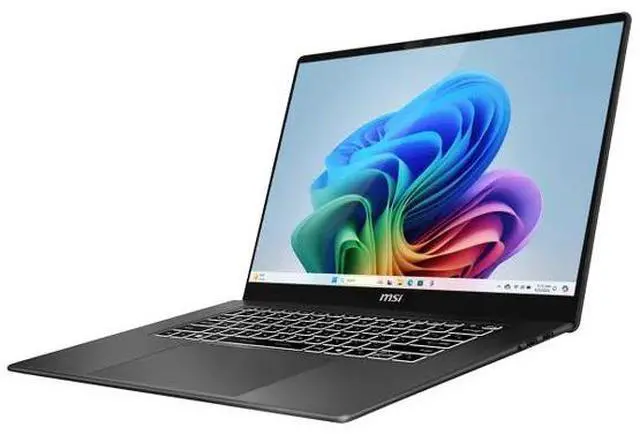
The MSI Prestige 16 AI+ is the showcase machine: a 16-core Core Ultra X7 358H boosting to 4.8GHz with Intel Arc B390 graphics, 32GB of LPDDR5x-8533, a 1TB NVMe drive, a 16-inch 2880 x 1800 120Hz OLED touchscreen covering 100% of DCI-P3, a 50 TOPS NPU and an 81Wh battery at 3.53 pounds. For something more conventional, the HP ProBook 4 G2i 14-inch uses a Core Ultra 7 Series 3 355 with 16GB of memory, a 512GB SSD, a 14-inch WUXGA IPS panel and Windows 11 Pro. And if you want the previous Lunar Lake generation in a premium chassis, the Lenovo ThinkPad X9-15 Gen 1 offers a Core Ultra 7 258V with Arc 140V graphics, 32GB of LPDDR5X-8533, a 15.3-inch 2880 x 1800 120Hz OLED touchscreen and an 80Wh battery at 3.09 pounds.
AMD Ryzen AI Laptops on Newegg
AMD’s strength here is memory capacity and value in mainstream 16-inch machines. The Lenovo IdeaPad Slim 5 16-inch uses the 8-core, 16-thread Ryzen AI 7 350 with Radeon 860M graphics, 32GB of DDR5-5600, a 1TB PCIe Gen4 drive and a 16-inch WUXGA touchscreen. The Dell 16 Plus Business uses the same processor with a 50 TOPS NPU, 16GB of DDR5-5600, a 1TB Gen4 drive, a 300-nit 16-inch touchscreen and Windows 11 Pro.
If You Also Game
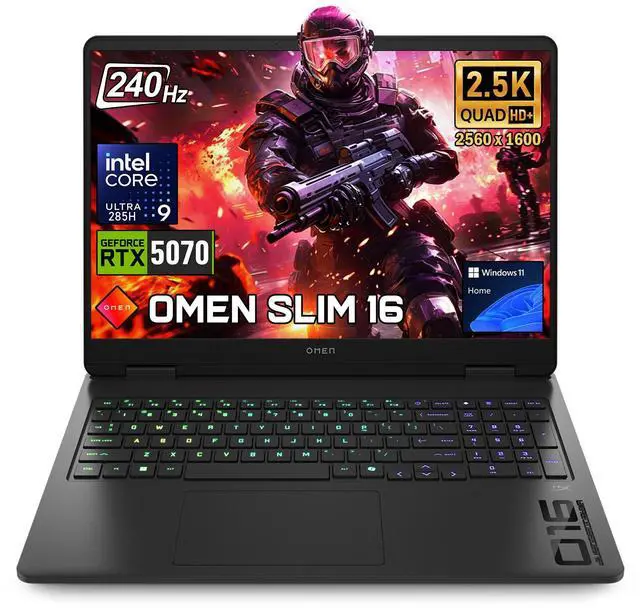
This is the one category where the decision is made for you. Kernel-level anti-cheat blocks Arm systems entirely, so if you play Valorant or Apex Legends you need an x86 machine with a discrete GPU. The HP Omen Slim 16 pairs a 16-core Core Ultra 9 285H with a GeForce RTX 5070 laptop GPU, 32GB of DDR5, a 1TB drive and a 16-inch 2560 x 1600 240Hz display.
Which Should You Buy? By Major
This is guidance drawn from the compatibility and battery evidence above rather than a vendor recommendation. Computer science: either works — native Arm64 builds of VS Code, Python and Git are mature. Choose x86 if your coursework involves x86-only Docker images, kernel work, or an x64-only lab VPN client. Engineering: choose x86. Specialized CAD and simulation suites and license-dongle drivers are the weakest area for Windows on Arm, and Panther Lake’s Arc B390 handles viewport work well. Design, photo and video: either; go Panther Lake if your workflow depends on Premiere Pro plugins. General studies and business: Snapdragon or Panther Lake, and prioritize a large battery — 80Wh or more — over the chip name. Gaming alongside school: x86 with discrete graphics, no exceptions.
Compare current configurations in Newegg’s student laptop listings.
Frequently Asked Questions
Is the Snapdragon X2 Elite really 87% faster than Intel’s Panther Lake? In one benchmark, under uneven conditions. The figure comes from a Qualcomm-commissioned Signal65 report and refers specifically to Cinebench 2026 multi-threaded against the Core Ultra X9 388H. The Snapdragon machine was tested on battery in Balanced mode while the Intel machine ran plugged in at Best Performance, and Intel’s Arc B390 graphics beat the Snapdragon’s GPU in the same report.
Which platform has the best battery life in 2026? It depends on the laptop, not just the chip. PCWorld’s streaming test put Panther Lake at around 16.5 hours versus 13 hours 4 minutes for the Snapdragon X2 Elite Extreme — but the Intel machine had a 99Wh battery. Per watt-hour, the first-generation Snapdragon X Elite remains the most efficient of the group.
What still does not work on a Windows on Arm laptop? Games with kernel-level anti-cheat such as Valorant and Apex Legends are blocked outright. Some older corporate VPN clients and driver-level utilities still require x86 or x64. And plugin ecosystems can fail even when the host app is native. Most mainstream productivity and creative software now has native Arm64 builds.
Should students wait for the newest chip? Generally no. The evidence this year is that a well-specified previous-generation machine with a large battery often beats a newer chip in a thinner chassis. Prioritize memory, storage, screen quality and battery capacity, and treat the processor as one factor among several.
Read More
- Tom’s Hardware: CPU Benchmarks Hierarchy — Rankings by gaming, single-threaded and multi-threaded performance plus integrated graphics.
- Windows on Arm Compatibility Database — A community-maintained list of which applications run natively, run emulated, or do not work.
- Intel: Core Ultra Processors — Official specifications for the 14 Core Ultra Series 3 SKUs.
- Tech Spurt: ASUS Zenbook A16 (2026) Review — A hands-on look at the retail Snapdragon X2 Elite Extreme laptop used in the Signal65 and PCWorld tests.
- Newegg: Student Laptops — Filter by processor, memory, storage and display size.