
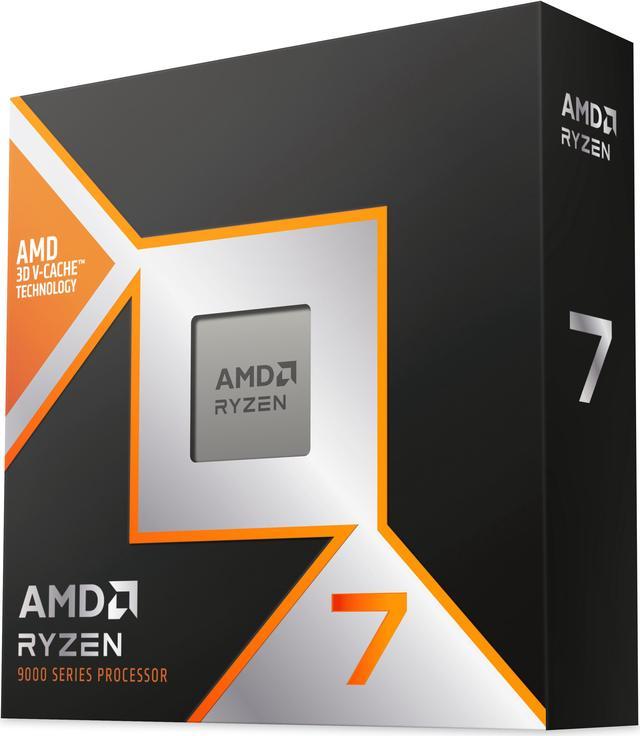
Every year, millions of PC gamers face the same fundamental question when building or upgrading their rigs: which CPU delivers the best gaming performance for the power it draws? In 2026, that question has become more interesting than ever. Intel’s Arrow Lake generation and AMD’s 3D V-Cache lineup have both matured, and a new challenger — the Ryzen 7 9850X3D — has entered the conversation. Whether you’re gaming at 1440p, concerned about your electricity bill, or just trying to future-proof your platform, the answer matters.
“Intel Core Ultra 7 265K vs Ryzen 7 7800X3D: Which Is Better for Gaming and Power Efficiency?”
This is the most-asked CPU comparison question of the past 18 months, and the answer in 2026 is clearer than it was at launch.
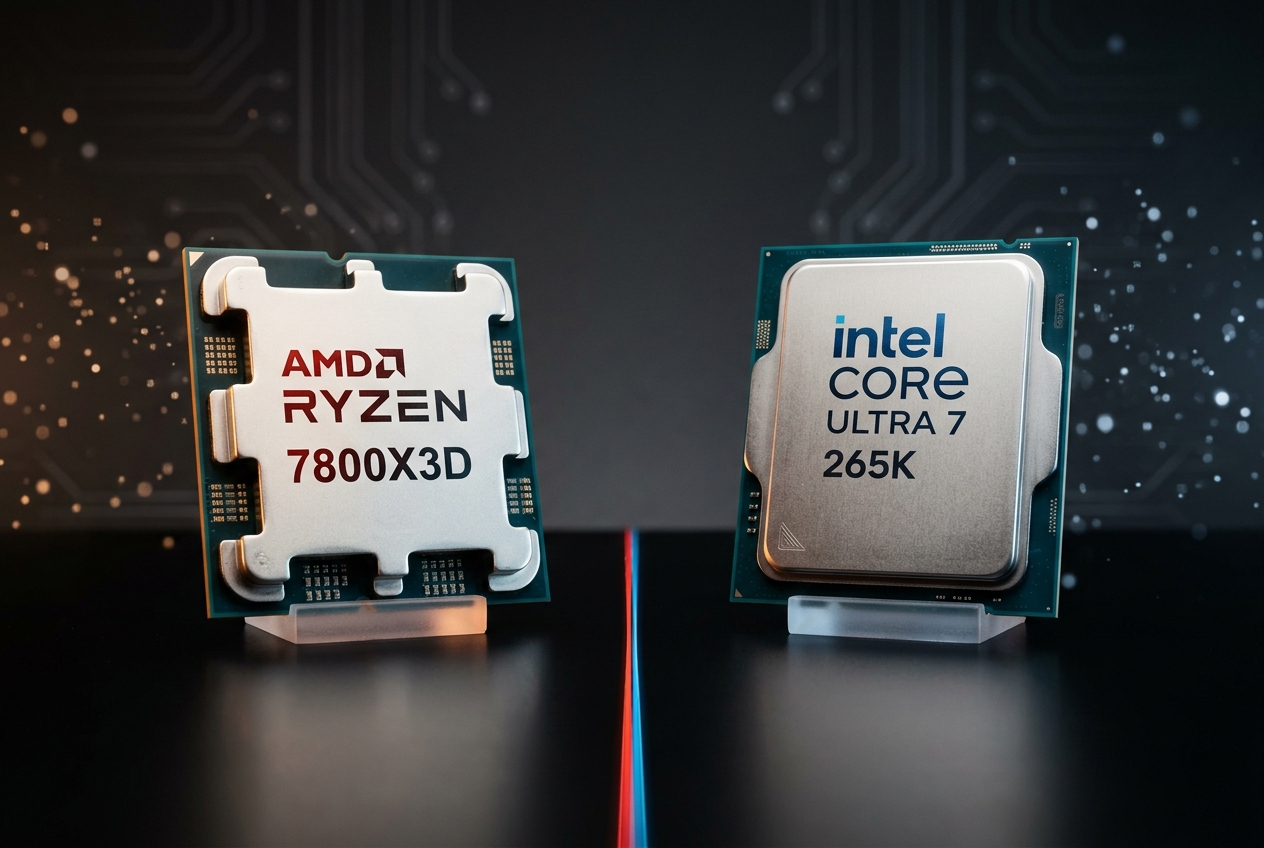
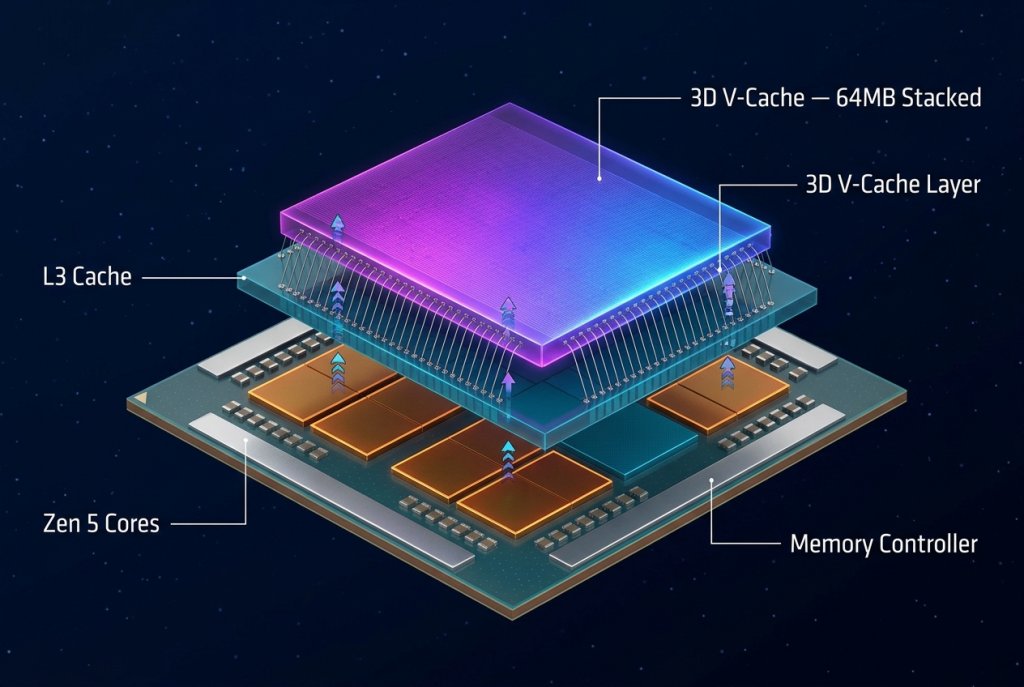
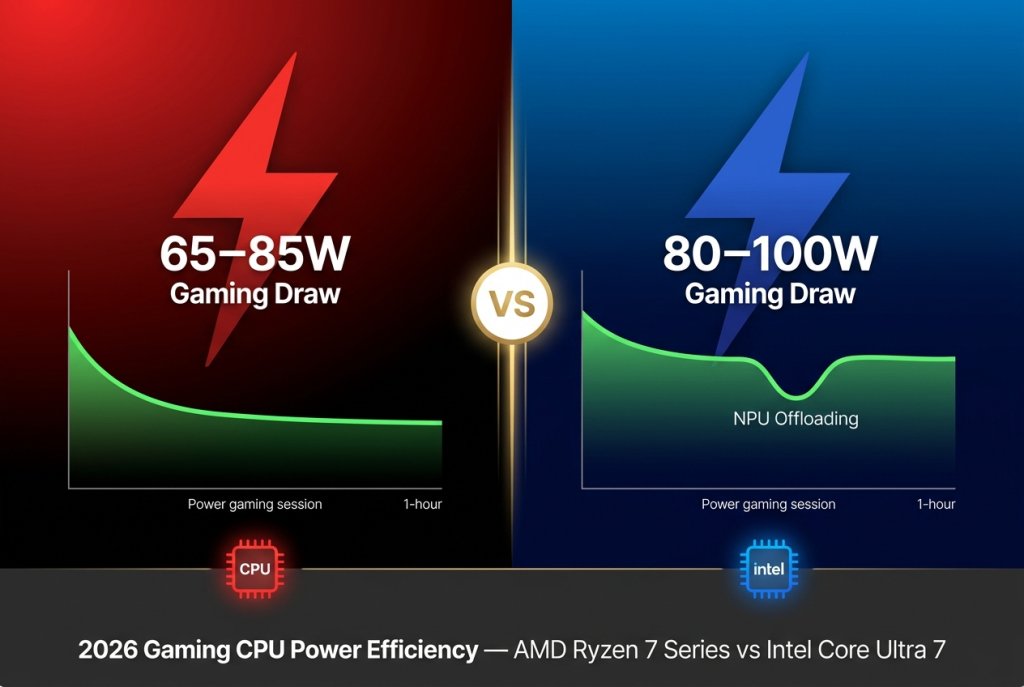
The AMD Ryzen 7 7800X3D remains one of the most efficient gaming processors ever made. Its 96MB of stacked 3D V-Cache dramatically reduces cache miss penalties in game engines, delivering high average frame rates and — critically — excellent 1% low performance. Under sustained gaming loads, the 7800X3D typically draws just 65–85W, keeping it quiet and cool even in compact builds.
The Intel Core Ultra 7 265K (Arrow Lake) takes a different approach. It abandoned the hybrid core scheduling issues that plagued Raptor Lake in older games and introduced a cleaner architecture with an integrated NPU (Neural Processing Unit) for on-device AI tasks. In gaming benchmarks, it trades blows with the 7800X3D depending on the title — multi-threaded games and those optimized for Intel’s instruction extensions favor the 265K, while open-world games with large asset streaming still lean toward AMD’s cache-heavy design.
| Processor | Architecture | L3 Cache | TDP | Avg Gaming Power Draw |
|---|---|---|---|---|
| Ryzen 7 7800X3D | Zen 4 + 3D V-Cache | 96MB | 120W | 65–85W |
| Core Ultra 7 265K | Arrow Lake | 36MB | 125W | 80–100W |
For pure gaming efficiency, the 7800X3D’s performance-per-watt ratio is still class-leading. For platform versatility — including NPU-accelerated AI features and better multi-threaded productivity — the Core Ultra 7 265K is the more balanced choice. Browse AMD’s full CPU lineup and Intel’s latest processors to find the right fit for your build.
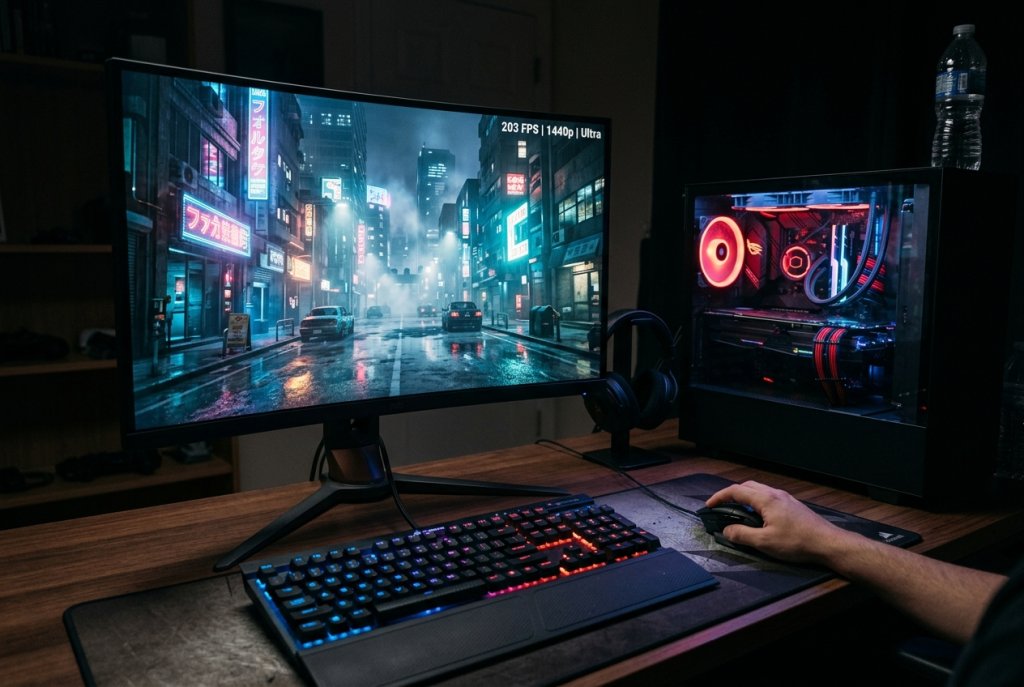 “How Does the Ryzen 7 9850X3D Compare to the Ryzen 7 7800X3D for 1440p Gaming and Power Draw?”
This is the upgrade question every AM5 platform owner is asking in 2026 — and the answer is: the 9850X3D is a meaningful leap.
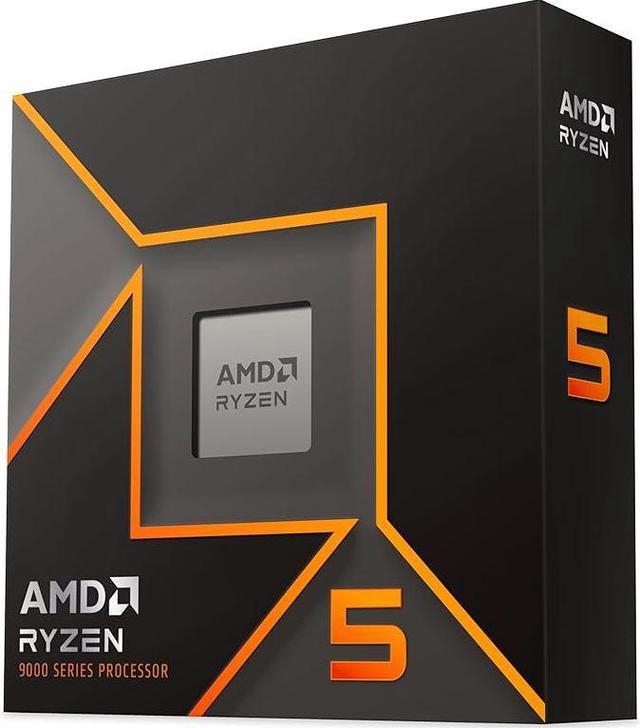
Built on AMD’s Zen 5 architecture with an expanded second-generation 3D V-Cache, the Ryzen 7 9850X3D delivers approximately 16% higher IPC compared to Zen 4. At 1440p, that translates to consistently higher average frame rates and stronger 1% lows across a wide range of titles — from Marvel Rivals to Assassin’s Creed Shadows.
| Processor | IPC vs Zen 4 | Avg FPS (1440p) | 1% Low FPS | Typical Gaming Draw |
|---|---|---|---|---|
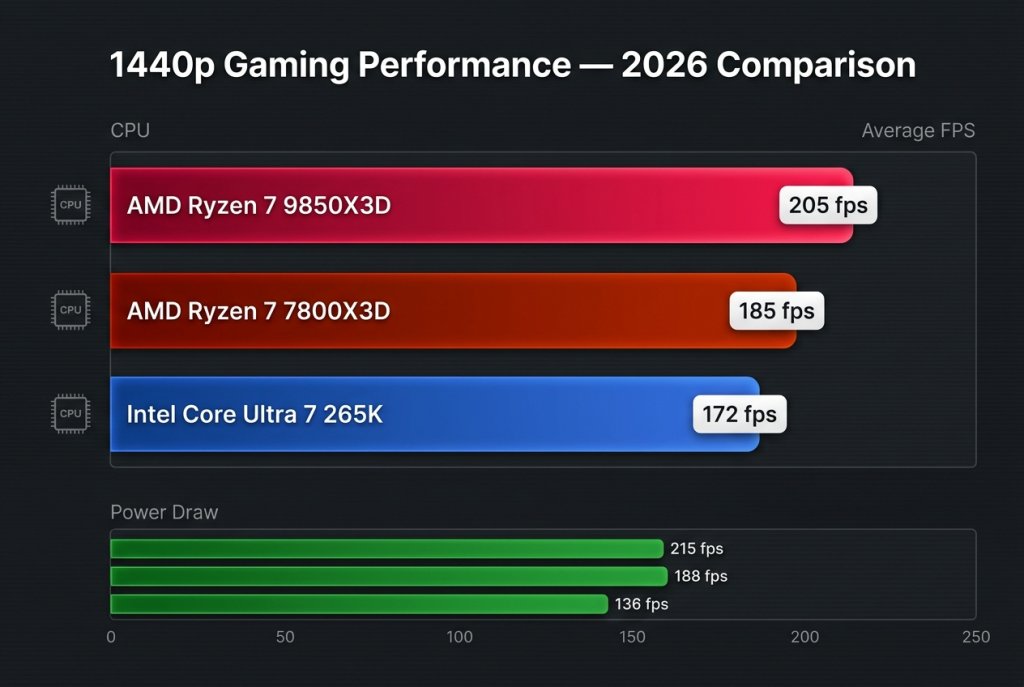
| Ryzen 7 7800X3D | Baseline | ~185 fps | ~155 fps | 65–85W |
| Ryzen 7 9850X3D | +16% (Zen 5) | ~205 fps | ~175 fps | 75–95W |
The 9850X3D draws slightly more power than its predecessor — about 10–15W more under load — but the performance gain per watt still improves versus prior generations. Crucially, it slots directly into existing AM5 motherboards with a BIOS update, giving 7800X3D owners a straightforward upgrade path without platform changes.
For new builds, the 9850X3D is the clear answer for 1440p gaming in 2026. For existing 7800X3D owners on tight budgets, the 7800X3D still handles 1440p gaming comfortably and doesn’t require an immediate upgrade.
 “How Does Power Efficiency Compare Between This CPU and Last Year’s Models?”
The generational efficiency story of AMD’s 3D V-Cache lineup is one of the most consistent improvements in recent PC hardware history. The 7800X3D (2023) set the benchmark for gaming efficiency; the 9850X3D improves absolute performance while maintaining a similar thermal envelope. Intel’s Arrow Lake similarly improved over Raptor Lake’s notorious power spikes, bringing peak draw down significantly with the Core Ultra 7 265K.
The efficiency gains become even more striking when zooming out to server and workstation silicon. The same architectural discipline that AMD applies to desktop CPUs scales across its entire product stack — from consumer chips to the professional-grade AMD Ryzen Threadripper PRO 7965WX, which packs 24 cores onto a platform designed for sustained professional workloads with ECC memory support. Intel’s approach similarly scales from the Core Ultra desktop lineup to the Xeon w9-3475X workstation processor with 36 cores and full ECC memory support.
 2026’s New Variable: AI in Gaming
By 2026, on-device AI has moved from a marketing talking point to a practical gaming feature. AMD’s RDNA 4 GPUs and Zen 5 CPUs now work in tandem with AI-assisted upscaling (FSR 4), AI-driven NPC behavior systems, and intelligent frame generation. Intel’s Arrow Lake NPU handles background AI inference — model-based streaming enhancements, highlight capture, and Copilot-integrated overlays — without taxing the GPU during gameplay.
Neither implementation transforms gaming overnight, but they represent the direction the platform is heading. Choosing a CPU in 2026 means choosing a platform for the next several years of AI-augmented gaming experiences.
 Which CPU Should You Choose?
- Best for 1440p gaming performance: Ryzen 7 9850X3D — the highest frame rates and 1% lows available at the desktop level
- Best for gaming + power efficiency: Ryzen 7 7800X3D — still outstanding, especially in systems where thermal headroom is limited
- Best balanced platform for gaming and productivity: Intel Core Ultra 7 265K — Arrow Lake’s NPU, DDR5 platform, and multi-core versatility make it the more rounded choice for users who work and game on the same machine
- For users who need professional-grade multi-core compute alongside their gaming workstation: the Ryzen Threadripper PRO 5955WX represents the workstation tier where gaming-adjacent workflows — 3D rendering, simulation, video production — demand a fundamentally different class of processor
The 2026 gaming CPU market rewards matching your processor to your actual workflow. For most gamers building or upgrading today, AMD’s 3D V-Cache architecture remains the gold standard — and the 9850X3D is its best expression yet.
Related Posts
- Best CPUs for Gaming and Productivity in 2026: Intel vs AMD Showdown
- Should You Buy an Unlocked CPU in 2026? A Practical Guide for Every Type of Builder
- Unlocked vs. Locked CPUs Explained: What the “K” Really Means in 2026
- Do You Actually Need a Xeon or Threadripper? A 2026 Workload Guide to Choosing the Right CPU Platform
- Desktop CPU vs. Server CPU: What’s Actually Different Under the Hood in 2026