
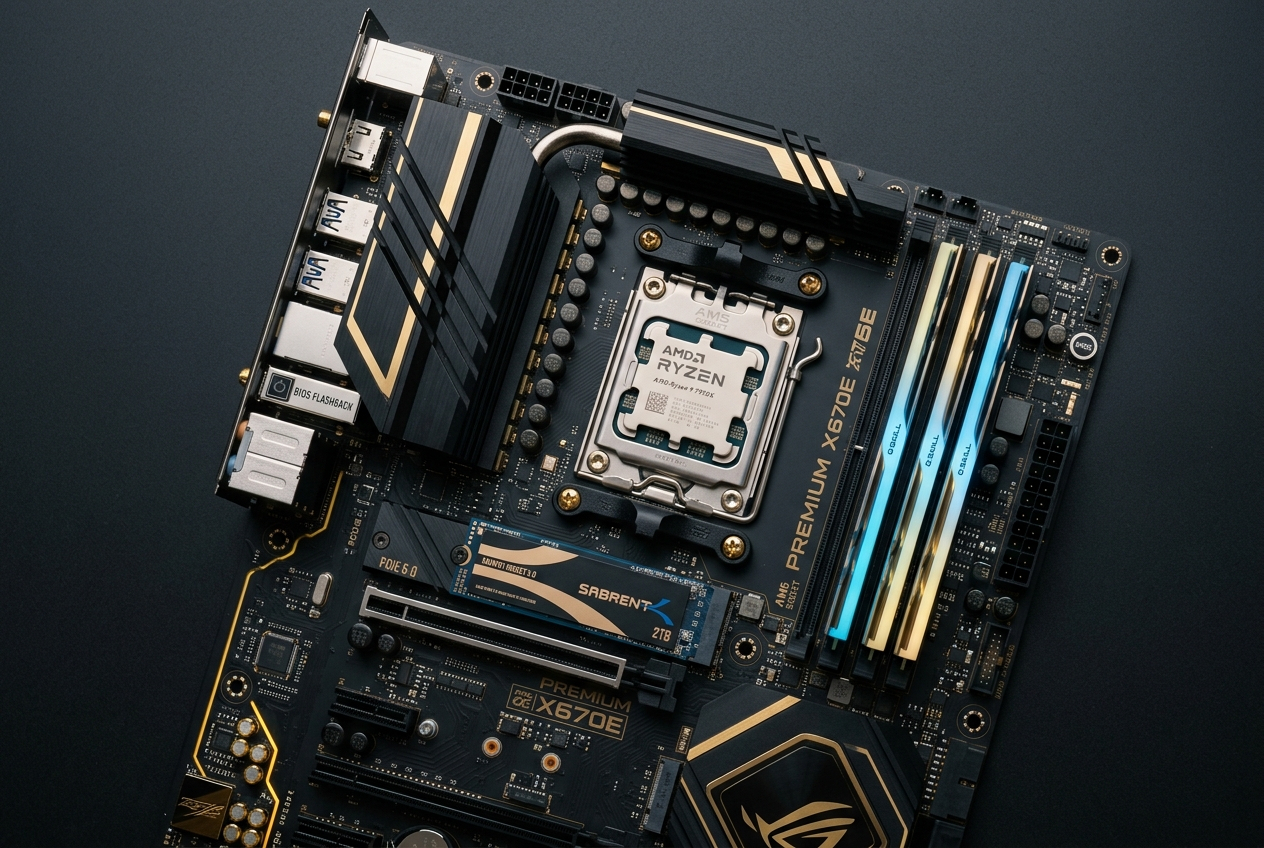
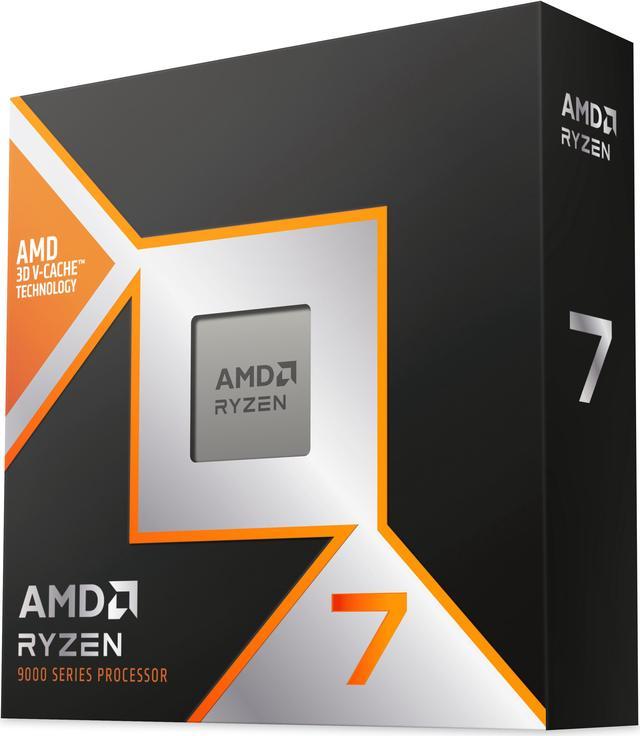
A processor is only as capable as the platform surrounding it. The AMD Ryzen 9 9950X3D2 Dual Edition sits on AMD’s AM5 socket — a platform that has matured significantly since its 2022 introduction and now represents one of the most capable and future-ready desktop ecosystems available. Understanding AM5’s infrastructure — its motherboard tiers, DDR5 memory dynamics, PCIe 5.0 bandwidth, and connectivity stack — is essential for building a system that extracts the full potential of the 9950X3D2.
AM5: A Mature Platform in 2026
AM5 launched alongside the Ryzen 7000 series in 2022 as AMD’s first DDR5-exclusive desktop socket. By 2026, it has accumulated four years of ecosystem development: widespread motherboard availability, mature BIOS support, extensive memory compatibility lists, and a proven track record with demanding workloads.
Critically, AMD has publicly committed to AM5 socket longevity through at least 2027 — a meaningfully longer lifecycle than AM4 competitors offered at comparable maturity. This means the 9950X3D2 is not a platform dead-end purchase; future Ryzen generations will remain compatible with today’s AM5 motherboards and DDR5 memory.
Motherboard Selection: Choosing the Right Tier
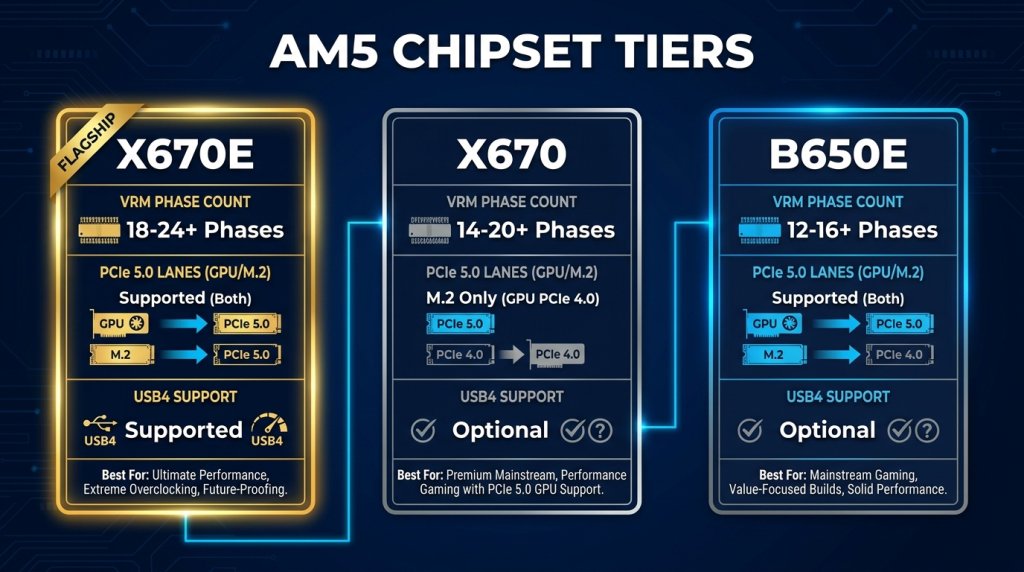
AM5 motherboards span four primary chipset tiers, each with different feature sets and power delivery capabilities:
| Chipset | VRM Power Delivery | PCIe 5.0 Lanes | USB 4 | Best For |
|---|---|---|---|---|
| X670E | Flagship (16+ phase) | GPU + M.2 | Yes | Maximum overclocking, full feature set |
| X670 | High (12–16 phase) | GPU only | Yes | High-end builds, slightly lower OC headroom |
| B650E | Mid-High (10–14 phase) | GPU + M.2 | Optional | Performance per dollar |
| B650 | Mid (8–12 phase) | GPU only | No | Budget-conscious AM5 builds |
For the 9950X3D2’s 170W TDP and potential boost behavior, X670E boards with high-quality VRM designs are strongly recommended. The processor’s dual V-Cache die stack means power delivery stability directly affects sustained performance — particularly under sustained multi-threaded workloads where the CPU maintains high clocks across all 16 cores.
X670E boards with 16+ phase power delivery, high-quality capacitors, and good PCB thermal management ensure the 9950X3D2 can sustain its rated performance without throttling. Look for boards that include EXPO memory profile support and have been validated for Ryzen 9000 series processors with the latest BIOS.
DDR5 Memory: Capacity, Speed, and EXPO Profiles
The 9950X3D2 requires DDR5 memory — there is no DDR4 compatibility on AM5. In 2026, DDR5 has become commodity hardware with a wide range of kits available at various speed grades.
What to prioritize for the 9950X3D2:
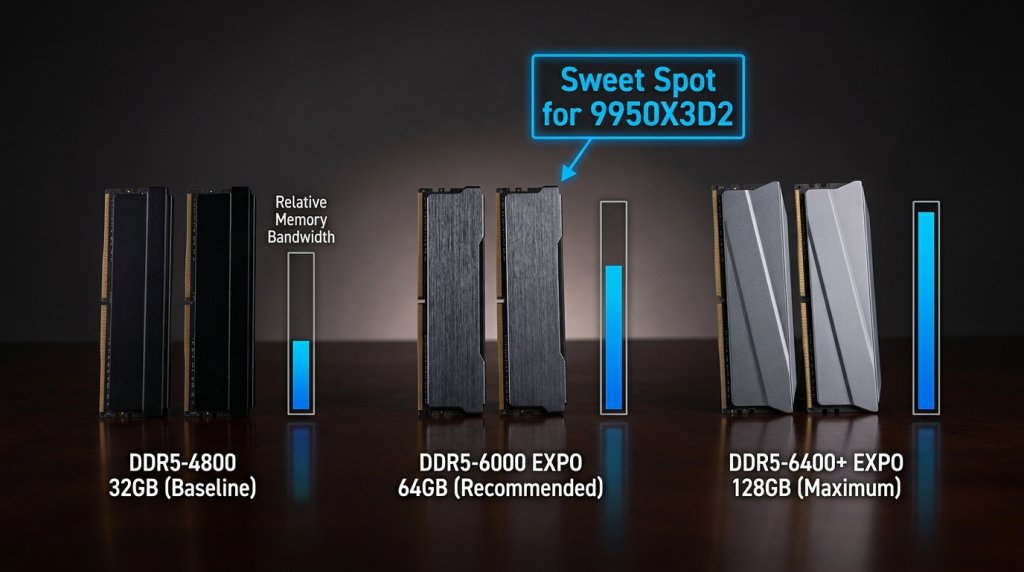
Capacity: 32 GB (2× 16 GB) is the minimum recommended configuration. For workstation and AI inference workloads, 64 GB (2× 32 GB or 4× 16 GB) provides headroom for large model contexts and multi-application environments. Running local 13B LLMs benefits materially from 64 GB of system RAM when the model doesn’t fully fit in L3 cache.
Speed: AMD’s EXPO (Extended Profiles for Overclocking) is the equivalent of Intel XMP on AM5. DDR5-6000 with EXPO represents the performance sweet spot for Ryzen 9000 series — it balances memory bandwidth with memory controller stability. Pushing beyond DDR5-6400+ is possible on quality kits with EXPO profiles, but stability requires careful pairing with validated X670E boards.
Dual-channel configuration: Always populate DDR5 in matched pairs for dual-channel operation. Dual-channel DDR5 doubles the memory bandwidth available to the processor compared to single-channel — particularly impactful for the 9950X3D2’s multi-threaded workloads where DRAM bandwidth complements the on-chip cache advantage.
PCIe 5.0: GPU and NVMe Bandwidth
AM5 natively supports PCIe 5.0 — the latest-generation interconnect standard with twice the bandwidth of PCIe 4.0 per lane. This affects two key components in a 9950X3D2 build:
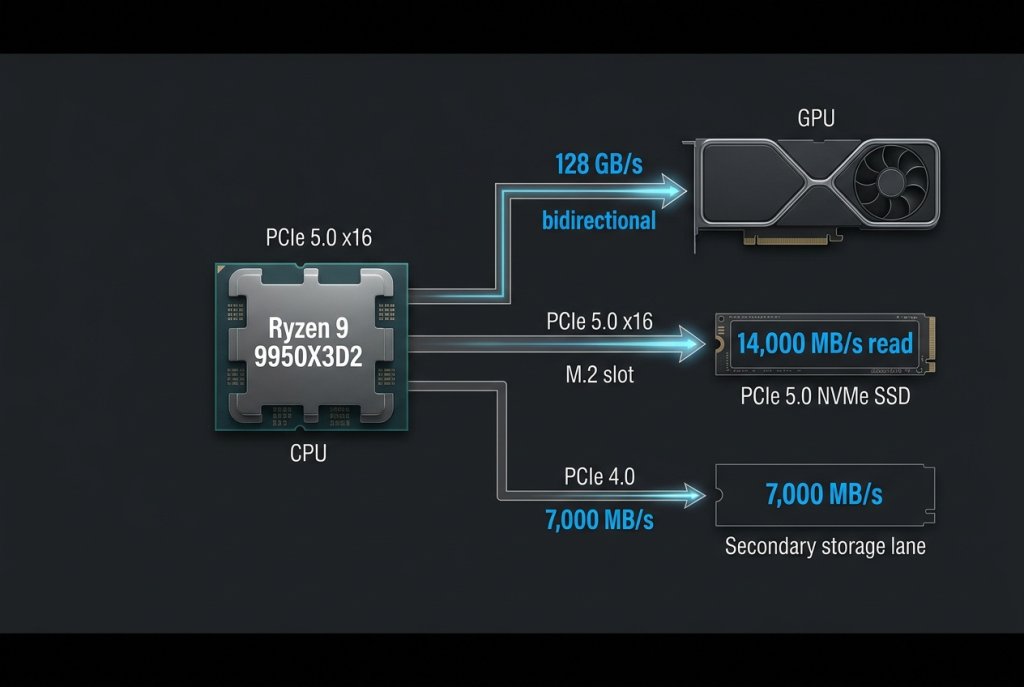
GPU connectivity: The primary x16 PCIe slot on AM5 boards runs at PCIe 5.0 x16, delivering 128 GB/s of bidirectional bandwidth. Current-generation GPUs do not saturate even PCIe 4.0 x16 under most gaming workloads — but the PCIe 5.0 slot future-proofs the platform for upcoming GPU generations.
NVMe SSD connectivity: X670E boards provide PCIe 5.0 M.2 slots for NVMe storage — the first platform tier to make PCIe 5.0 SSDs mainstream. PCIe 5.0 NVMe drives offer sequential read speeds of 12,000–14,000 MB/s, compared to 7,000 MB/s for PCIe 4.0. For workloads that stream large assets — video editing, AI dataset processing, high-resolution 3D scene files — this bandwidth uplift is meaningful. PCIe 5.0 NVMe drives pair particularly well with the 9950X3D2’s cache-rich architecture: high-speed data delivery to the processor complements the expanded L3’s ability to retain that data once loaded.
USB4 and Connectivity Stack
X670E and X670 boards include USB4 (40 Gbps) connectivity — the same underlying standard as Thunderbolt 4. USB4 enables:
- External GPU enclosures (eGPU) at meaningful bandwidth
- High-speed external NVMe enclosures (up to 40 Gbps)
- Single-cable docking stations for multi-display, audio, and networking
For professional users building around the 9950X3D2 for creative workloads, USB4 enables a clean cable-managed desk setup with full-bandwidth external peripherals — an increasingly important consideration in hybrid home/office workflows.
How the 9950X3D2 Platform Compares to Professional Alternatives
One of the most compelling aspects of AM5 for the 9950X3D2 is its accessibility compared to workstation platforms. Consider the infrastructure differences:
The AMD Ryzen Threadripper PRO 5955WX requires WRX80 workstation boards with 8-channel DDR4 ECC memory — a platform with limited motherboard options and a more complex ecosystem. The Intel Xeon w9-3475X demands LGA4677 workstation motherboards with Xeon-specific memory configurations. For the AMD EPYC 9554, the SP5 server platform requires enterprise infrastructure entirely.
AM5 offers consumer-grade accessibility — broad motherboard competition keeping quality high, standard DDR5 memory widely available, and a familiar ATX/mATX/ITX form factor ecosystem. The 9950X3D2 inherits all of this without requiring enterprise purchasing channels or specialized integrators.
Recommended Build Configuration for the 9950X3D2
For users building a complete system around the 9950X3D2:
- Motherboard: X670E with 16+ phase VRM, EXPO support, PCIe 5.0 M.2 slot
- Memory: DDR5-6000 64 GB (2× 32 GB) with EXPO profile, matched pair
- Primary NVMe: PCIe 5.0 M.2 NVMe SSD (1–2 TB for OS and active projects)
- Secondary Storage: PCIe 4.0 NVMe for archive and media storage
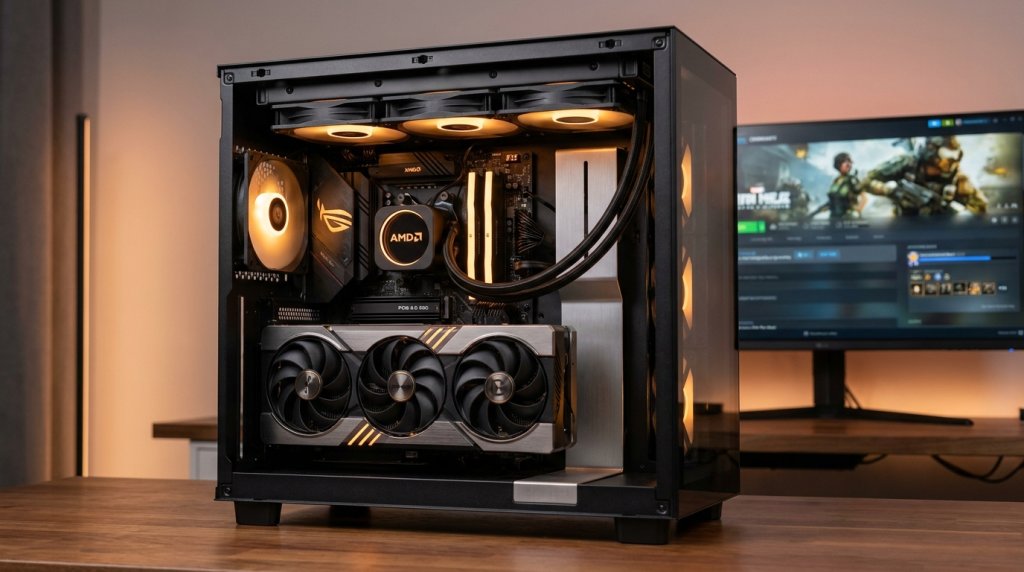
- Cooling: 360mm AIO or high-performance tower cooler (discussed in detail separately)
- Power Supply: 850W–1000W 80+ Gold or Platinum for headroom under full system load
This configuration unlocks the 9950X3D2’s full capability stack — maximum memory bandwidth, PCIe 5.0 storage throughput, and sustained CPU performance under the most demanding workloads.
The Bottom Line
The AM5 platform in 2026 is one of AMD’s most mature and well-supported desktop ecosystems. For the Ryzen 9 9950X3D2 Dual Edition, building on a quality X670E motherboard with DDR5-6000 memory and PCIe 5.0 NVMe storage unlocks the processor’s full capability — and the platform’s confirmed longevity means today’s investment supports future Ryzen upgrades as well.
Full product details are available on the AMD official page and the Newegg listing.