
Power and heat are the invisible governors of every high-performance processor. A CPU’s on-paper specifications only translate into real-world performance when its thermal and power delivery systems can sustain peak operation without throttling. For the AMD Ryzen 9 9950X3D2 Dual Edition — a processor carrying dual stacked 3D V-Cache dies on a 16-core Zen 5 foundation — understanding power behavior and thermal management is essential for anyone building or upgrading around this processor.
TDP and Power Architecture: What 170W Actually Means
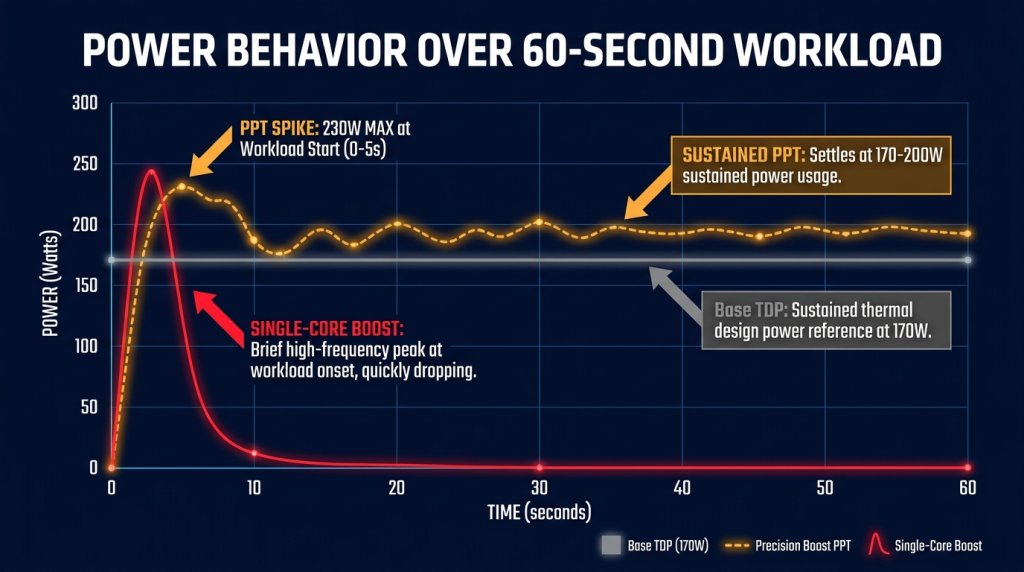
The Ryzen 9 9950X3D2 carries a rated TDP of 170W — identical to the standard Ryzen 9 9950X. This figure, however, tells only part of the story. TDP (Thermal Design Power) represents the sustained power level the cooler must handle, not the peak power draw during brief boost episodes.
AMD’s Precision Boost algorithm manages the 9950X3D2’s power behavior dynamically:
- Base TDP (170W): The sustained power level for extended all-core workloads — what your cooler is sized against
- PPT (Package Power Tracking): The actual maximum power package limit, which can exceed TDP during burst scenarios — on AM5 at default settings, this reaches 230W for Ryzen 9000 series
- Peak Boost (single core): Brief single-core spikes to maximum boost clocks that may draw significantly more power momentarily before the algorithm settles into sustained operation
The critical insight: the 9950X3D2’s dual V-Cache stack slightly constrains maximum boost clocks compared to the non-V-Cache 9950X. This is a deliberate architectural trade-off — the V-Cache silicon sits between the compute dies and the IHS, adding a small thermal resistance layer. AMD compensates by tuning the boost algorithm conservatively to prevent the stacked dies from reaching temperatures that would degrade performance or longevity.
In practice, this means the 9950X3D2 operates within its thermal envelope more consistently than a non-V-Cache processor at equivalent TDP — a characteristic that makes it easier to cool effectively.
Zen 5 Power Efficiency: More Performance Per Watt
One of the least-discussed improvements in Zen 5 over Zen 4 is power efficiency. TSMC’s N4 process node provides meaningful improvements in transistor leakage and dynamic power consumption compared to N5:
| Generation | Node | IPC Uplift vs Prior | Power Efficiency |
|---|---|---|---|
| Zen 4 (Ryzen 7000) | TSMC N5 | +13% over Zen 3 | Good |
| Zen 5 (Ryzen 9000) | TSMC N4 | +16% over Zen 4 | Better (+~15% perf/W) |
For the 9950X3D2, this means that its 170W TDP delivers more computational throughput than a 170W Zen 4 processor would have — the same power budget does more work. Compared to legacy professional processors like the Intel Xeon E3-1230 V2 or Intel Xeon E3-1230 V5, the efficiency differential is enormous — the 9950X3D2 delivers dramatically more throughput within the same or lower thermal envelope than those older Xeon generations.
The Dual V-Cache Thermal Challenge
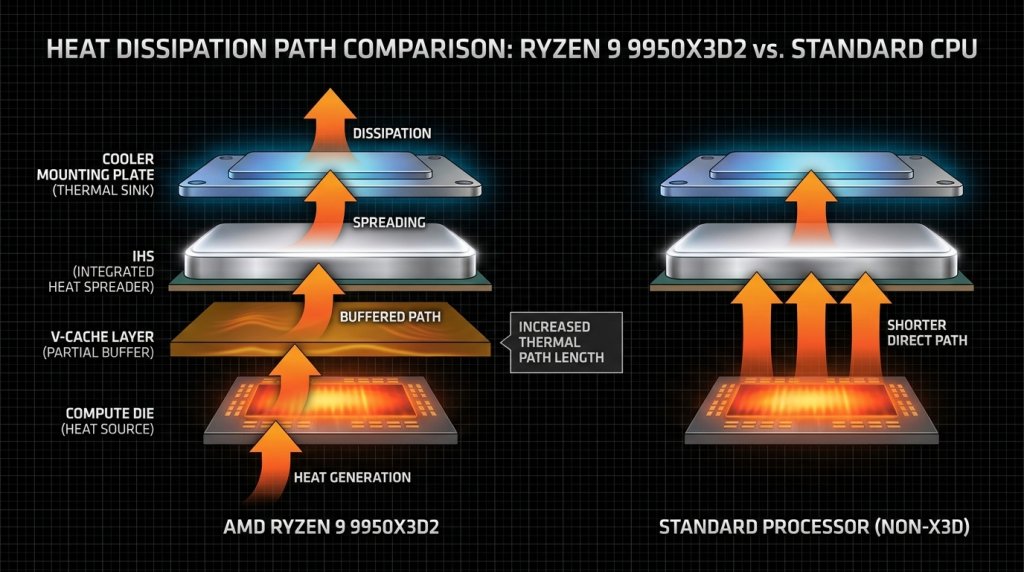
The dual 3D V-Cache architecture introduces a specific thermal consideration worth understanding: heat dissipation path length.
In a standard processor, heat flows from the compute die directly to the IHS (Integrated Heat Spreader) and then to the cooler. In the 9950X3D2, the V-Cache die sits above the compute die — meaning heat must pass through two silicon layers before reaching the IHS. This extends the thermal resistance path, which has two practical implications:
- The IHS temperature may run slightly lower than an equivalent non-V-Cache chip at the same power, because the V-Cache acts as a partial thermal buffer
- The junction temperature of the compute die (Tj) runs hotter than IHS measurements suggest, because heat must travel through the V-Cache before escaping
AMD addresses this through:
- Tighter TIM (Thermal Interface Material) formulation between die layers
- Conservative PPT limits that prevent the compute die from reaching unsafe Tj temperatures
- A CPU-internal temperature monitor that includes an offset correction for the V-Cache thermal delta
Practically, this means users should not apply aggressive overclocking through voltage increases on the 9950X3D2 — the thermal headroom through the stacked die path is more constrained than on standard processors. AMD’s Precision Boost handles performance optimization automatically and safely.
Cooling Requirements: What You Actually Need
Given the 9950X3D2’s 170W TDP with 230W PPT headroom, cooling selection matters. Here are the recommended tiers:
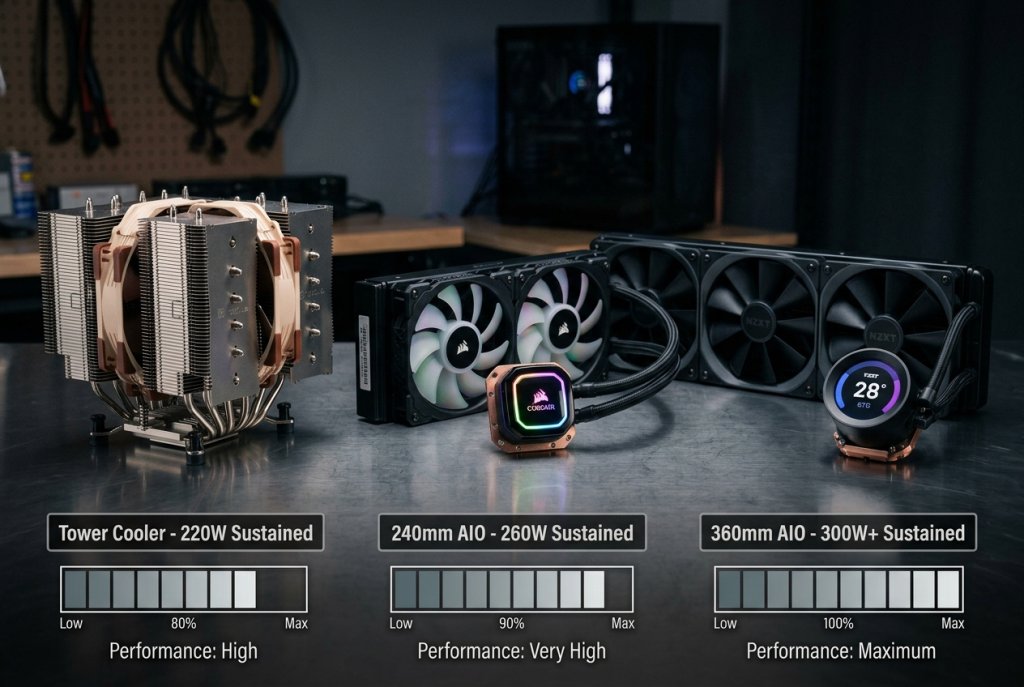
Minimum: High-Performance Tower Cooler (240W+ rated)
Large tower coolers with dual 120mm or 140mm fans — rated at 240W or higher by their manufacturers — can handle the 9950X3D2 under all but the most sustained multi-threaded workloads. Look for towers with 6mm+ heat pipe diameter and direct-contact base plates for optimal heat extraction from the IHS.
Suitable for: Gaming workloads, light multi-threaded tasks, mixed gaming/productivity use
Recommended: 240mm AIO Liquid Cooler
A quality 240mm AIO (All-in-One) liquid cooler provides reliable thermal performance across the 9950X3D2’s full operating range. The larger radiator surface area handles sustained all-core loads better than most tower coolers, and the remote radiator mount improves case airflow dynamics.
Suitable for: Mixed gaming and productivity, sustained rendering jobs, moderate professional workloads
Optimal: 360mm AIO Liquid Cooler
For sustained all-core workloads — extended rendering sessions, local AI inference running for hours, EDA simulations — a 360mm AIO provides the thermal headroom to sustain the 9950X3D2 at maximum Precision Boost frequencies continuously. The lower operating temperatures also contribute to processor longevity under sustained professional use.
Suitable for: Full professional workloads, AI inference, sustained rendering, maximum sustained performance
| Cooling Solution | TDP Headroom | Noise Level | Best Use Case |
|---|---|---|---|
| Large Tower (240W+) | 220W sustained | Moderate | Gaming, light mixed work |
| 240mm AIO | 260W sustained | Low-Moderate | Mixed gaming/productivity |
| 360mm AIO | 300W+ sustained | Low | Professional, AI, rendering |
Power Supply Sizing for a Full 9950X3D2 System
The 9950X3D2 in a complete gaming or workstation system shares PSU headroom with the GPU, storage, and platform components. Recommended PSU sizing:
- Gaming system (mid-high GPU): 850W 80+ Gold minimum
- Creative workstation (high-end GPU + heavy storage): 1000W 80+ Gold or Platinum
- AI inference rig (GPU + CPU sustained): 1000W–1200W 80+ Platinum
Modular or fully modular PSUs simplify cable management in builds with multiple NVMe drives and the 9950X3D2’s demanding power delivery requirements.
Eco Mode and Power Profiles: Tuning for Efficiency
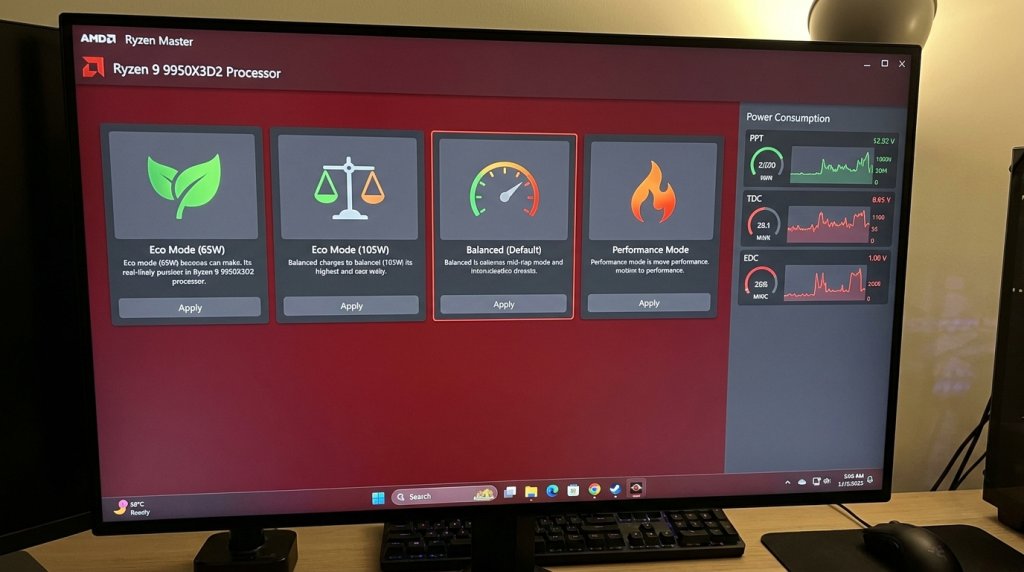
AMD provides software power profiles through AMD Software: Adrenalin Edition and the Ryzen Master utility:
- Eco Mode (65W or 105W): Dramatically reduces power draw at modest performance cost — useful for low-load tasks or when thermals are constrained
- Balanced (Default): AMD’s standard Precision Boost behavior — excellent performance/watt
- Performance Mode: Lifts PPT limits slightly for maximum sustained throughput
- Overclock profiles: Available via Ryzen Master for users who want manual control within safe Tj limits
For the 9950X3D2 specifically, Eco Mode at 105W is particularly interesting: it reduces the processor to a power level comparable to older workstation processors like the AMD EPYC 7262 while delivering dramatically superior single-threaded and cache-sensitive performance. This makes the 9950X3D2 versatile across very different use contexts on the same machine.
The Bottom Line
The Ryzen 9 9950X3D2’s power and thermal story is one of careful engineering trade-offs. The dual V-Cache stack adds thermal path length but operates within the same 170W TDP as the standard 9950X. Zen 5’s N4 efficiency means that wattage does more work than on prior-generation equivalents. And with the right cooling solution — ideally a 360mm AIO for sustained professional use — the processor delivers its full performance potential without throttling.
For full specifications, visit the official AMD product page or the Newegg listing.
Related Posts
- AMD Ryzen 9 9950X3D2 Dual Edition Gaming Performance: What Dual 3D V-Cache Changes for Gamers
- AMD Ryzen 9 9950X3D2 Dual Edition: Inside the World’s First Dual 3D V-Cache Desktop Processor
- CPU Performance Myths: Cores vs Cache vs Clock Speed — What Actually Boosts FPS and Render Time?
- Smart PC Upgrades with AI: Your Questions About Newegg’s PC Upgrader, Answered
- Build Your First Home NAS with Newegg’s NAS Builder: Three Real Scenarios