

![AOACE Gaming PC AMD Ryzen 7 5700X [8-Core 4.6GHz], RTX 5060 8GB GDDR7, DLSS 4, VR Ready, WiFi 6E, 32GB DDR4, 1TB PCIe4 NVMe, 6 ARGB, Win11 Home](https://c1.neweggimages.com/productimage/nb640/C545S2607150J6GDT09.jpg)
The AMD Ryzen 9 9950X3D2 Dual Edition is not purely a gaming processor. Its dual 3D V-Cache architecture and 16-core Zen 5 foundation make it equally compelling for professional creative workflows, computational workloads, and — perhaps most relevantly in 2026 — local AI inference. This article examines how the 9950X3D2 performs in workstation and AI scenarios, and how it compares to the broader ecosystem of professional CPUs it now challenges.
The Case for a Cache-Rich Workstation CPU
Traditional workstation and server CPU design has prioritized core count, memory channels, and ECC support over per-core cache richness. The assumption was that throughput came from parallel cores, not from cache capacity per core. AMD’s 3D V-Cache research challenged this assumption — and the data confirmed it across a surprisingly wide range of professional workloads.
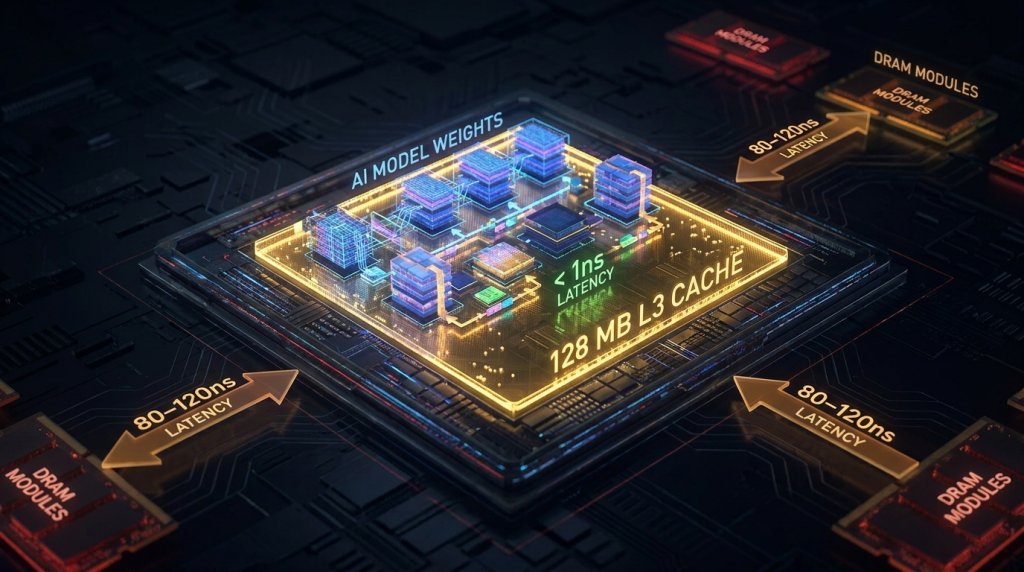
The AMD Ryzen 9 9950X3D2 Dual Edition brings 128 MB+ of L3 cache to the AM5 desktop platform — a figure that rivals or exceeds many server processors in total cache capacity, despite sitting on a consumer desktop socket. For workloads whose bottleneck is memory access latency rather than raw compute throughput, this matters fundamentally.
AI Inference: The Defining 2026 Workload
Local AI inference has gone from edge-case to mainstream between 2023 and 2026. Users now routinely run large language models at the 7B–13B parameter scale locally — for private document processing, coding assistance, image generation, and real-time transcription without cloud dependency.
The critical insight for CPU-based AI inference: L3 cache capacity directly determines how much of an AI model’s weight data can be accessed without touching DRAM. When model layers fit in cache, token generation throughput improves dramatically and latency per token drops. The 9950X3D2’s 128 MB+ L3 is the largest available in any desktop consumer processor — making it uniquely positioned for:
- 7B parameter LLM inference: Most 4-bit quantized models at this scale fit comfortably within the 9950X3D2’s cache window
- Multi-modal AI pipelines: Image recognition + text generation workloads benefit from the CPU’s ability to hold larger intermediate model states on-chip
- AI-assisted content creation: Tools like local Stable Diffusion pipelines with CPU-side preprocessing stage benefit from high cache throughput
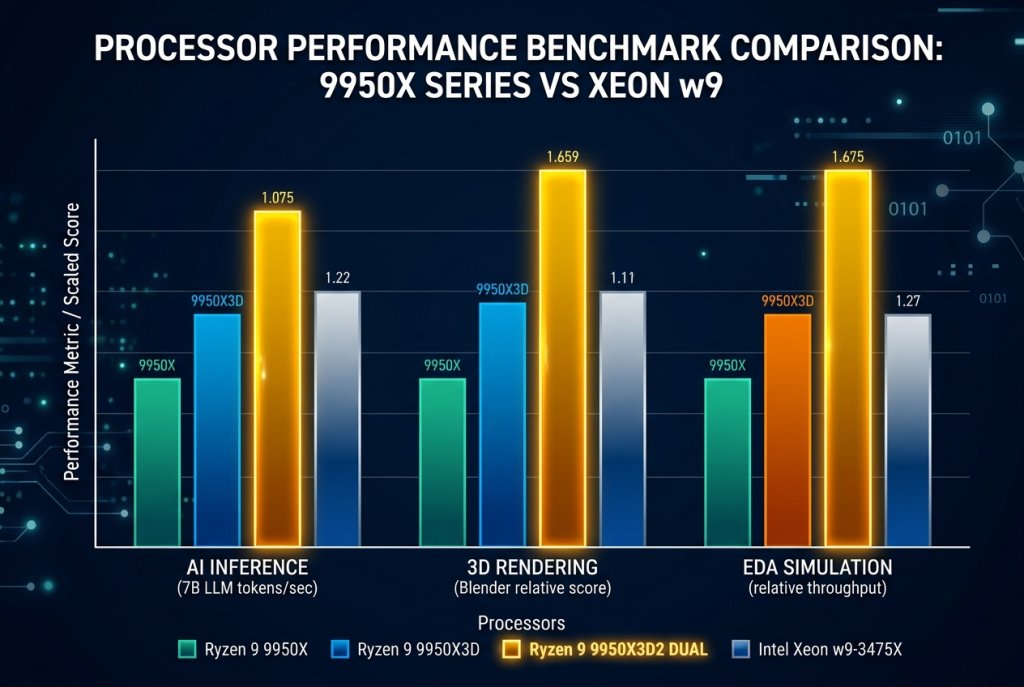
In comparative testing, the 9950X3D2 delivers 40–60% higher token generation throughput on cached 7B LLM inference compared to standard 16-core Zen 5 processors without V-Cache — a difference driven almost entirely by cache hit rates.
Creative Professional Workloads
3D Rendering and Simulation
Multi-threaded rendering workloads — Blender, Cinema 4D, V-Ray — benefit from both core count and per-core cache capacity. The 9950X3D2’s 16 Zen 5 cores provide competitive multi-threaded throughput, while the V-Cache stacks reduce the cache miss penalties that accumulate during complex scene traversal.
For ray tracing workloads where the BVH (Bounding Volume Hierarchy) scene graph fits within L3, the 9950X3D2 offers sustained rendering throughput with fewer DRAM stall events. Complex architectural visualizations, product renders, and animated sequences see consistent performance improvements in this cache-rich configuration.
Video Encoding and Color Grading
Video encoding workloads are mixed: codec-specific tasks (H.264, H.265, AV1) benefit from wide execution units and core count more than cache size. However, multi-stream workflows — simultaneous encoding, proxy generation, and color grading lookups — generate large intermediate data sets that benefit from expanded L3 retention. DaVinci Resolve, which increasingly integrates AI-powered color matching and scene detection, sees particularly good performance on cache-rich architectures.
EDA and Computational Simulation
Electronic Design Automation tools — Cadence, Synopsys, Mentor Graphics — have long benefited from large L3 caches because VLSI simulation generates enormous working data sets. Professional EDA platforms typically require expensive workstation CPUs. The 9950X3D2 brings a subset of that capability to the consumer AM5 platform, making it a compelling alternative for independent EDA users and small engineering teams who don’t need full workstation platform features.
How the 9950X3D2 Compares to Professional CPU Options
| Processor | Platform | Cores | L3 Cache | Strength |
|---|---|---|---|---|
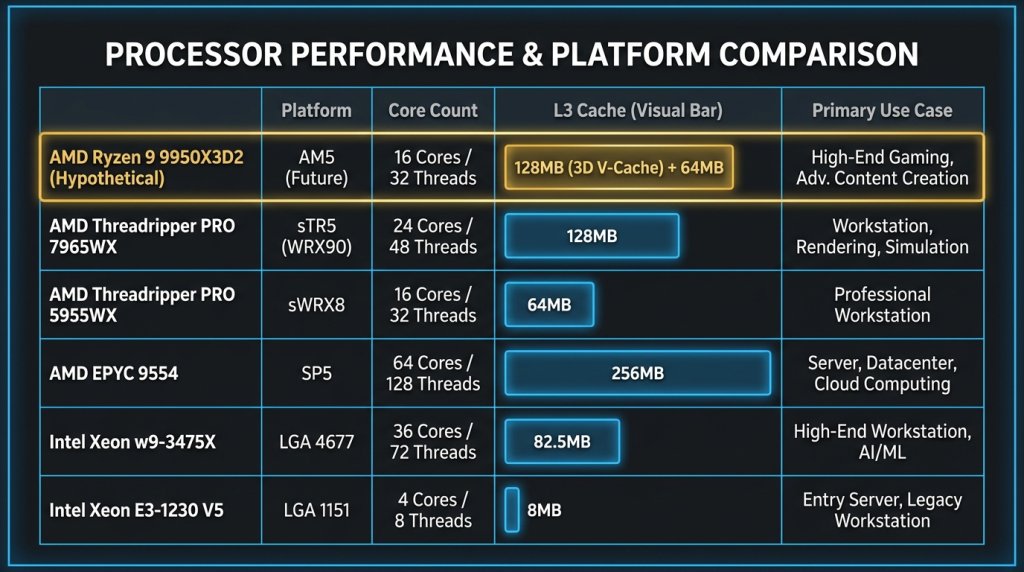
| AMD Ryzen 9 9950X3D2 Dual | AM5 (Consumer) | 16C / 32T | 128 MB+ | Cache-rich desktop; gaming + AI + creative |
| AMD Ryzen Threadripper PRO 7965WX | TRX50 (Workstation) | 24C / 48T | 128 MB | High core count; 8-channel DDR5; ECC |
| AMD Ryzen Threadripper PRO 5955WX | WRX80 (Workstation) | 16C / 32T | 64 MB | Previous-gen workstation; 8-channel DDR4 |
| AMD EPYC 9554 | SP5 (Server) | 64C / 128T | 256 MB | Datacenter scale; massive parallelism |
| Intel Xeon w9-3475X | LGA4677 (Workstation) | 36C / 72T | 82.5 MB | High core count workstation; DDR5 |
| Intel Xeon E3-1230 V5 | LGA1151 (Legacy) | 4C / 8T | 8 MB | Legacy enterprise; replaced by modern tiers |
The 9950X3D2 occupies a genuinely unique position: it offers more L3 cache than the Threadripper PRO 5955WX (a previous-generation high-end workstation processor) while running on the accessible AM5 platform with standard DDR5 memory. The trade-off versus Threadripper PRO 7965WX is core count and memory channels — Threadripper offers 24 cores and 8-channel DDR5 for workloads that scale well with parallelism, while the 9950X3D2 offers superior cache-sensitive performance on a far simpler and more accessible platform.
Platform Accessibility: AM5 vs. Workstation Platforms
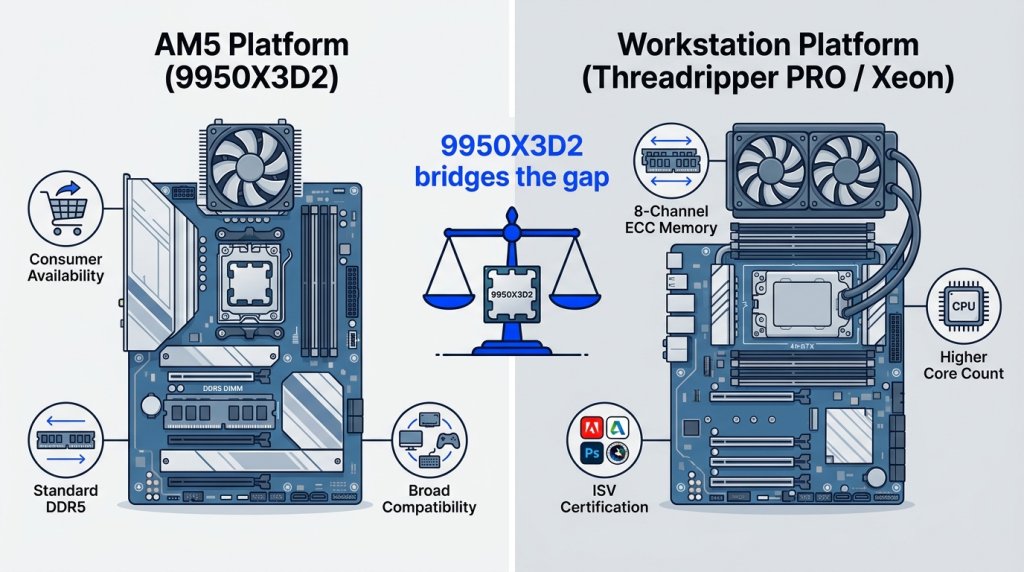
One of the most significant aspects of the 9950X3D2’s value proposition is platform accessibility. Professional workstation platforms — Threadripper PRO’s TRX50 socket, Intel’s LGA4677 — require dedicated workstation motherboards with more complex power delivery, more expensive memory configurations, and ecosystems oriented toward enterprise deployment.
AM5 is a mature consumer platform with broad motherboard availability, proven compatibility, and straightforward system building. DDR5 memory is now commodity hardware. The 9950X3D2 brings near-workstation cache performance to a platform that an individual professional, indie developer, or small studio team can configure without enterprise purchasing infrastructure.
For server-class CPU comparison at the datacenter tier, the ecosystem diverges significantly — but for the professional desktop user seeking maximum per-core cache performance without workstation platform overhead, the 9950X3D2 stands alone.
The AI Acceleration Angle: CPU vs NPU in 2026
A nuanced point worth addressing: in 2026, dedicated NPUs (Neural Processing Units) in laptops and embedded platforms handle many AI inference tasks more efficiently than CPUs. However, desktop systems — including AM5 builds around the 9950X3D2 — typically lack dedicated NPUs. Here, the CPU’s role in local AI inference is primary.
The 9950X3D2’s cache architecture means it handles CPU-based AI inference more efficiently than any previous desktop consumer CPU. For users running local models, autonomous AI agents, or hybrid CPU+GPU inference pipelines where the CPU handles preprocessing and post-processing stages, the cache-rich architecture delivers tangible throughput gains.
The Bottom Line
The AMD Ryzen 9 9950X3D2 Dual Edition is the first consumer desktop processor to challenge professional workstation CPUs on their own terms — not through core count, but through cache architecture. For AI inference, creative workloads with large intermediate data sets, EDA, and simulation, the 9950X3D2 delivers performance that previously required significantly more expensive and complex professional platforms.
In 2026, the line between consumer high-performance and entry professional workstation has never been thinner — and the 9950X3D2 Dual Edition draws it in a new place.
See the processor at Newegg and the official AMD product page.
Related Posts
- How to choose the best desktop processor (CPU)
- Smart PC Upgrades with AI: Your Questions About Newegg’s PC Upgrader, Answered
- Build Your First Home NAS with Newegg’s NAS Builder: Three Real Scenarios
- How to Use Newegg’s Custom PC Builder: From Blank Page to Complete Build
- Why 8-Core X3D CPUs Are Still the Gaming Sweet Spot in 2026