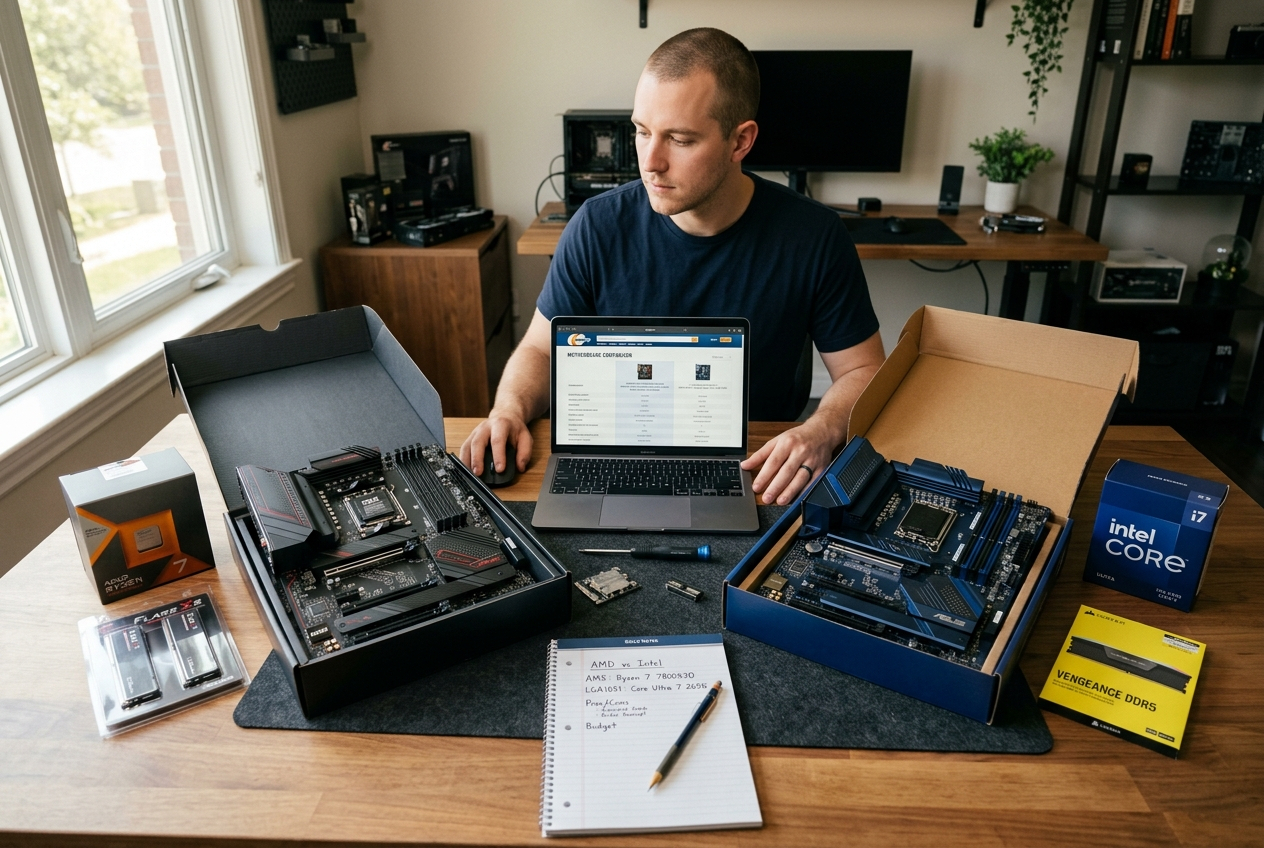
The question “What is the difference between AMD and Intel motherboards?” is rarely just a technical one. For most buyers in 2026, it translates to something more practical: which platform should I build on, and what does that decision commit me to? The motherboard is the foundation of your entire system — it determines which CPUs you can use, which memory runs at what speed, how many GPUs and NVMe drives you can install, and whether your platform can grow alongside your needs over the next several years. This guide organizes the AMD vs. Intel motherboard decision around the scenarios that actually drive purchases in 2026.
If You’re Building a Gaming PC
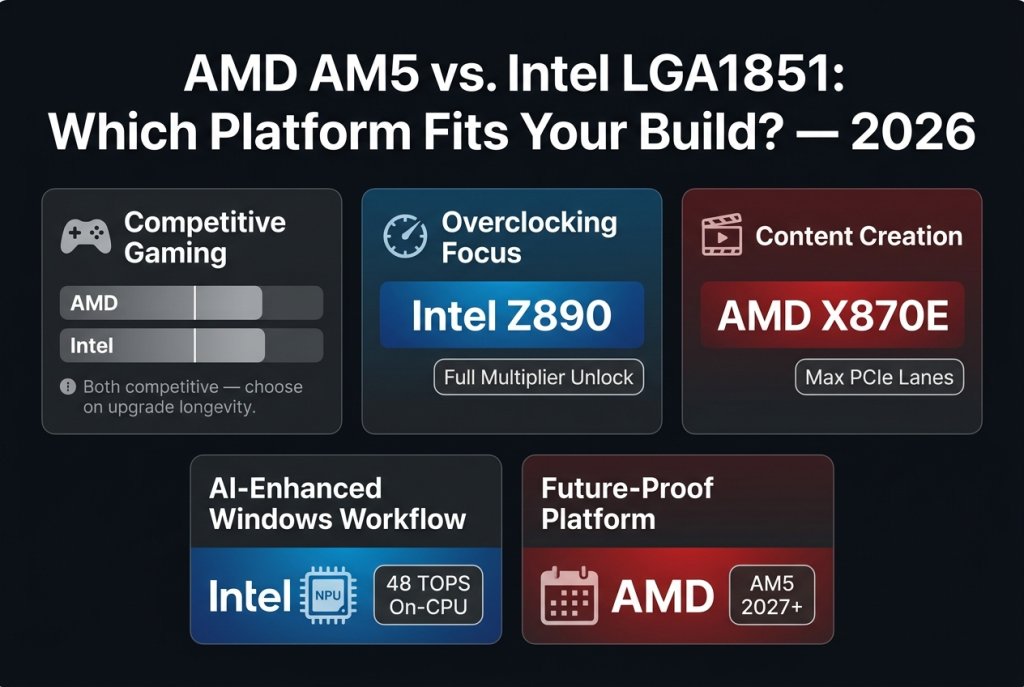
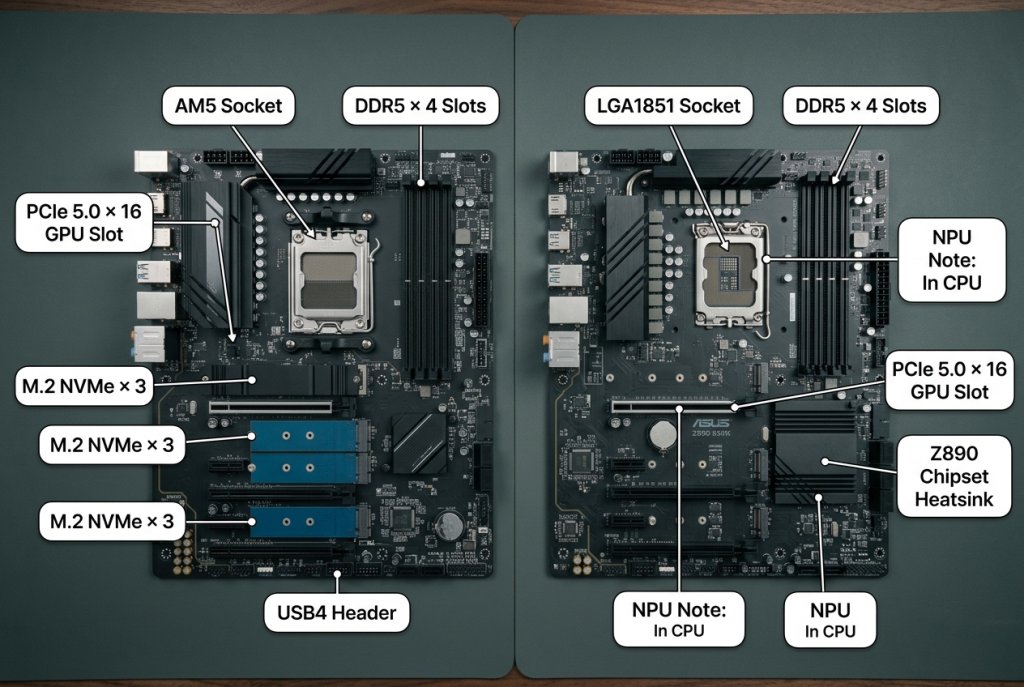
For gaming-focused builds, both AMD AM5 and Intel LGA1851 motherboards deliver competitive platform capabilities in 2026. The practical differences come down to three variables: chipset access to overclocking, memory sweet spot, and platform upgrade longevity.
AMD AM5 gaming advantage: AMD’s Precision Boost Overdrive (PBO) is available on all AM5 chipsets, including the mid-range B850 — meaning a budget board can still tune boost behavior for better sustained gaming performance. The AMD Ryzen platform also benefits from strong AM5 socket longevity — AMD’s commitment to support future Zen 6 CPUs on the same socket means your board investment extends further into the platform cycle.
Intel LGA1851 gaming advantage: Intel’s Z890 chipset provides the cleanest path to traditional multiplier overclocking with K-series CPUs. For competitive gamers at 1080p where single-threaded performance is the primary bottleneck, a Core Ultra K-series CPU on a Z890 board delivers strong, tunable performance.
For most gamers choosing between a mid-range AMD B850 board with an AMD CPU Processor and a comparable Intel B860 board with an Intel CPU Processor, real-world gaming performance at 1440p is close enough that the better decision driver is platform longevity and upgrade plans, not benchmark split.
 If You’re Building a Content Creation or AI Workstation
Content creators and AI developers working in 2026 often have requirements that push beyond standard gaming configurations: more NVMe storage slots, stable sustained multi-threaded performance, and in some cases, AI acceleration at the platform level.
AMD’s X870E and X870 chipsets offer the most PCIe 5.0 lane availability for multi-SSD and multi-GPU configurations. Pairing an AMD Ryzen 9000 series CPU with a premium GIGABYTE or ASUS X870E board provides a dense I/O configuration suitable for multi-drive storage arrays, multiple GPU & Video Graphics cards, and fast SSD expansion.
Intel’s LGA1851 Z890 platform includes the Arrow Lake CPU’s integrated 48 TOPS NPU — a feature with growing relevance as Microsoft’s AI-integrated creative tools (Adobe Firefly background processing, Premiere Pro AI scene detection, Copilot-powered project management) increasingly use on-device AI inference. For creators who spend significant time in Windows AI-enhanced applications, the Intel platform’s NPU integration reduces the GPU compute load during background AI tasks.
Choosing Your Chipset Tier: A Platform Comparison
| Use Case | AMD Recommendation | Intel Recommendation | Key Reason |
|---|---|---|---|
| Budget gaming build | B650 board | B860 board | Mid-range competitive chipsets |
| Mainstream gaming | B850 board | B860 board | PBO (AMD) / XMP (Intel) both work well |
| High-end gaming + OC | X870 board | Z890 board | Full overclocking platform |
| Content creation | X870E board | Z890 board | Maximum PCIe lanes and storage |
| Small form factor build | AM5 Mini-ITX | LGA1851 Mini-ITX | Both ecosystems support Mini-ITX |
| Future CPU upgrade path | AM5 (Zen 6 support confirmed) | LGA1851 (current gen) | AM5 longevity advantage |
 Form Factor: ATX, Micro-ATX, and Mini-ITX
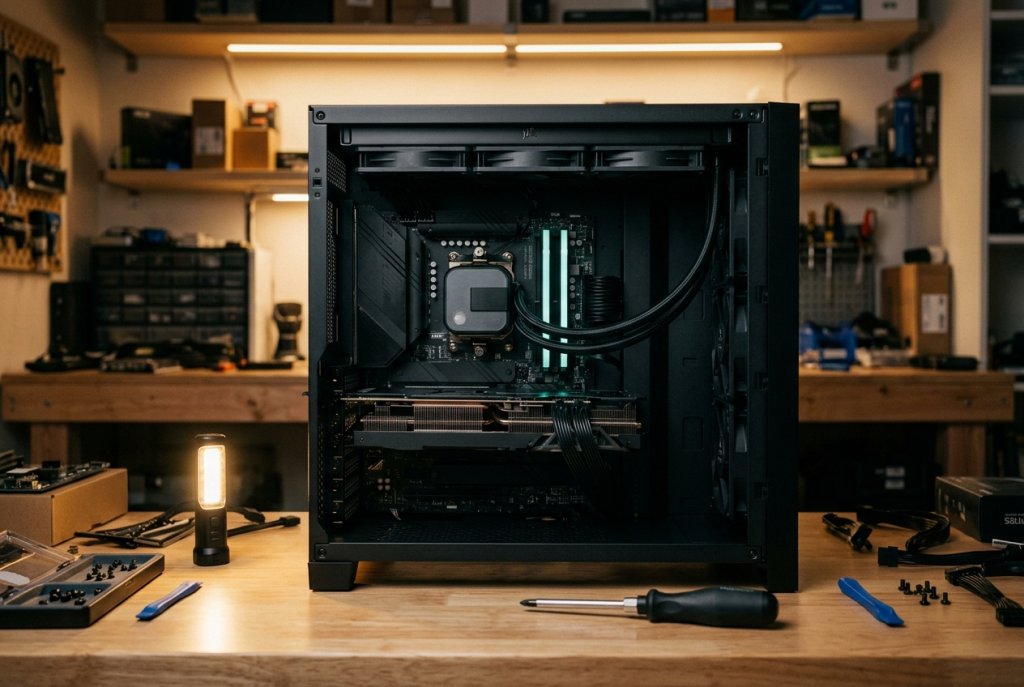
Both AMD and Intel motherboard ecosystems are available in all standard form factors. Your case choice determines which form factor makes sense:
- ATX motherboards offer the most expansion slots, VRM phases, and I/O options for both platforms. Best for desktop workstations with room for full GPU cards and multi-drive builds.
- Micro-ATX boards reduce physical size while retaining most practical capabilities — one fewer PCIe slot in most designs. A strong choice for compact tower builds.
- Mini-ITX enables small form factor builds in cube and compact computer cases, with one PCIe slot and typically two DIMM slots. Both AMD and Intel have solid Mini-ITX board options from all major manufacturers for 2026 builds.
For builders looking at ATX-compatible computer cases, standard ATX dimensions are identical across AMD and Intel boards — your case is platform-agnostic.
 Brand Selection: Which Manufacturer for Your Platform?
ASUS, GIGABYTE, MSI, and ASRock all produce high-quality boards for both AMD AM5 and Intel LGA1851. Platform choice does not lock you into a specific manufacturer. Within each brand, product lines segment by use case:
- ASUS ROG / MSI MEG — premium gaming and overclocking, available on both platforms
- ASUS ProArt / GIGABYTE AORUS Master — content creation and workstation focus
- MSI PRO / ASRock Steel Legend — mid-range with strong value-to-feature ratios
- ASRock / GIGABYTE B-series — budget-tier boards with solid feature sets for everyday gaming
Memory and Power Supply Considerations
Both platforms require DDR5 memory exclusively on 2026-generation boards. If you have existing DDR4 sticks from a previous build, they are not compatible with either current-gen platform — DDR5 kits are required for both AM5 and LGA1851.
Both platforms also require an ATX 3.0-compatible power supply for full next-generation GPU support, particularly for systems pairing an RTX 50 series GPU via the PCIe 5.0 ×16 slot. An 80+ Gold or Platinum rated ATX 3.0 PSU ensures stable delivery under combined CPU and GPU peak loads.
Most 2026 boards on both platforms include Wi-Fi 7 as standard. Check the Wi-Fi motherboard listings on Newegg to filter by Wi-Fi generation if wireless connectivity is a requirement for your build.
 Making the Final Call
The AMD vs. Intel motherboard decision in 2026 comes down to three questions: Do you value platform upgrade longevity (AM5 advantage)? Do you want full multiplier overclocking (Intel Z890 advantage)? Are Windows AI features a priority in your workflow (Intel NPU advantage)? All other capabilities — PCIe 5.0, DDR5, Wi-Fi 7, form factor diversity — are available on both platforms from all major manufacturers. Browse the complete CPU & Processor and motherboard catalog on Newegg to compare configurations side by side — and build on the platform that answers your specific questions correctly.